

Safe Distances Around Swings and Slides: Space Planning Guide
The Short Version: Keep at least 6 feet, about 1.8 metres, of clear ground around play equipment, and in front of and behind swings keep a clear distance equal to twice the height of the swing beam. Mark the full safety zone on the ground before you buy, and never let a slide exit, path or fence sit inside it.
Quick Answer: Safe distances around swings and slides start with 6 feet, about 1.8 metres, of clear space in every direction around the equipment. For swings, the front and back clearance is larger: twice the height of the top bar the swings hang from, measured from the beam line. A swing set with a 2.1 metre beam therefore needs about 4.2 metres of clear ground in front and the same behind.
Safe Distances Around Swings and Slides: The Basic Rules
The size of a swing set on a website is the size of its frame, but the space it needs in your garden is much bigger. Around every piece of play equipment there must be a clear safety zone, an area of open, soft ground where a child can fall, jump off or fly off a swing without hitting a fence, a wall, a tree or another piece of equipment. Getting this zone right is the most important part of planning a play area, and it is the part most families underestimate. In short, this guide explains the safe distances around swings and slides, with real measurements you can use in a Saudi villa garden.
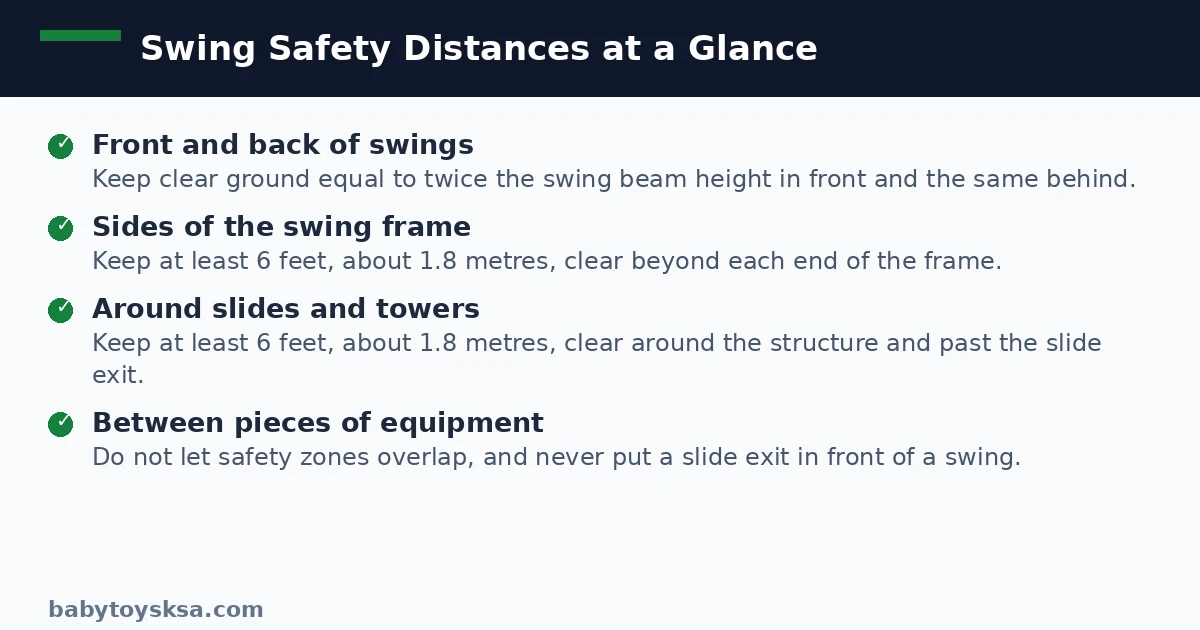
The figures in this guide come from the United States Consumer Product Safety Commission, known as the CPSC, whose public playground safety handbook and home playground handbook set out the standard safety zones used around the world. The CPSC guidance asks for at least 6 feet, about 1.8 metres, of clear space in all directions from the edge of play equipment, measured to any fence, wall, tree, building or other obstacle. Swings need more than that in front and behind, because a swinging child travels a long way. For swings, the clear zone in front and behind must be at least twice the height of the top bar the swings hang from, measured from the beam line. To the sides of a swing frame, the 6 feet rule applies. In fact, these are guidance figures for home gardens, not law, but they are the figures professional installers work to, and they are the safest way to plan your space.
What European Guidance Says (EN 1176)
European guidance under EN 1176, the European playground equipment standard, works in a similar way, with an impact area around equipment that grows with the height children can fall from. Above a fall height of 0.6 metres, impact absorbing surfacing must cover the whole impact area, and for fall heights between 0.6 and 1.5 metres the impact area extends 1.5 metres from the equipment. The two systems use different numbers, but they agree on the principle. The taller the equipment and the further a child can travel on it, the bigger the clear zone must be. Finally, this guide uses the CPSC figures, because they are the clearest for home gardens, and notes where EN 1176 differs.
How Much Space Does a Swing Set Really Need
Work out the swing zone before you fall in love with a particular set, because the zone decides whether the set fits your garden. Start with the beam height, the height of the top bar the swings hang from, measured from the ground or from the top of the safety surfacing. Double that number. That is the clear distance you need in front of the swings, and the same distance again behind them, measured from the line of the beam. Then add 6 feet, about 1.8 metres, beyond each end of the frame for the sides.
A real example makes this clear. Our four seat swing set with red frame measures 400 by 130 by 210 cm, at 1050 SAR. Its beam height is about 2.1 metres, so the front and back zones are each about 4.2 metres. The frame itself is 4 metres wide, so with 1.8 metres clear at each end, the side to side zone is about 7.6 metres. Add the frame depth of about 1.3 metres between the front and back zones, and the full clear area is roughly 9.7 metres deep by 7.6 metres wide. That is far bigger than the 4 by 1.3 metre footprint of the frame alone, and it is the area you must have clear before this set is safe to use. In fact, a two seat set is smaller, but the rule is the same, and the zone is still much bigger than the frame.
If the Zone Surprises You, Choose a Smaller Set
That size surprises most buyers, and it is the most common reason a playset ends up squeezed against a fence. The answer is not to shrink the safety zone, but to choose a set that fits the space you have. A compact two seat swing set, or a swing and slide combination that shares one zone, may suit a smaller garden better than a large four seat frame. Our swing set with two seats and blue and red frame measures 200 by 120 by 210 cm, at 750 SAR, and its zone, while still generous, is much smaller than the four seat set. Finally, use our Design Finder tool to plan your layout, and measure the zone on the ground with rope or tape before you order, so there are no surprises on installation day.
Safe Distances in Front of and Behind Swings
The front and back zones are the most important distances on a swing set, because that is where a child travels. A child swinging high moves forward and back in a long arc, and a child who jumps or falls from a swing at the top of that arc can land well in front of or behind the frame. That is why the CPSC asks for twice the beam height in each direction, rather than a fixed number of feet. A taller swing set throws a child further, so it needs a longer zone. Never shorten this zone because the garden feels tight. A swing zone that ends at a fence, a wall or a pool is a swing that should not be used.
The front and rear zones must never overlap with any other use zone. That means no slide exit, no seesaw, no bench, no path and no other piece of equipment inside the swing corridor. The sides are different. The 6 feet side zones may overlap with a neighbouring structure, but the front and back zones belong to the swings alone. This is also why the layout of your garden matters. Put the swing bay at the edge of the play area, with its front and back zones running across open ground, and run paths behind the uprights rather than across the arc. In fact, if children have to walk through the swing zone to reach the slide, they will do it, and sooner or later a swinging seat will meet a walking child.
A Practical Check: Walk the Zone Yourself
For a practical check, stand at the beam and walk twice the beam height forward, marking the spot, then do the same backwards. Everything between those two marks, across the full width of the frame plus 1.8 metres at each end, must stay clear, with safety surfacing underneath. If a fence, tree or wall falls inside that area, the set is in the wrong place. Moving a swing set after installation is a big job, so get the position right the first time. Finally, our installation team measures and marks the zone before we install, and we will tell you honestly if a set does not fit the space you have.
Safe Distances Around Slides and Towers
Slides need their own clear zone, and the most important part is the exit. The CPSC guidance asks for at least 6 feet, about 1.8 metres, of clear, surfaced ground in front of a slide exit for slides up to 6 feet high, and for taller slides the exit zone runs at least as far as the slide is high, up to a maximum of 8 feet. The exit zone is where children land, sometimes faster than they expect, so keep it free of walls, fences, paths and other equipment, with safety surfacing underneath. A slide that exits towards a fence, a pool or a swing arc is not safe, however good the slide itself is.
Around the rest of a slide or tower playset, the 6 feet rule applies, measured from the edge of the structure in every direction. For a large tower set, that adds up quickly. Our large tower playset with tunnel slide, yellow slide, green spiral slide and swings measures 700 by 440 by 360 cm, at 7400 SAR. Its footprint alone is 7 by 4.4 metres, and with 1.8 metres clear on every side, the clear area becomes about 10.6 by 8 metres. That is a big area, and it is the reason large tower sets suit large villa gardens, school yards and compounds, while a compact set suits smaller gardens better. In short, check the numbers for your garden before you choose, not after.
Space Between the Parts of a Combination Set
Also think about the space between the parts of a combination set. On a swing and slide combination, the slide exit must not point into the swing zone, and the swing zone must not cross the slide exit. Children move between the two constantly, so the layout should make the safe route obvious. Keep the climbing side of a tower away from the swing bay, so a child climbing up does not step into the path of a swinging seat. Finally, if your set has a tunnel slide or a spiral slide, remember that children exit them facing a fixed direction, so plan the exit zone for that direction, and keep it clear.
Planning Safe Distances for Swings and Slides in a Small Garden
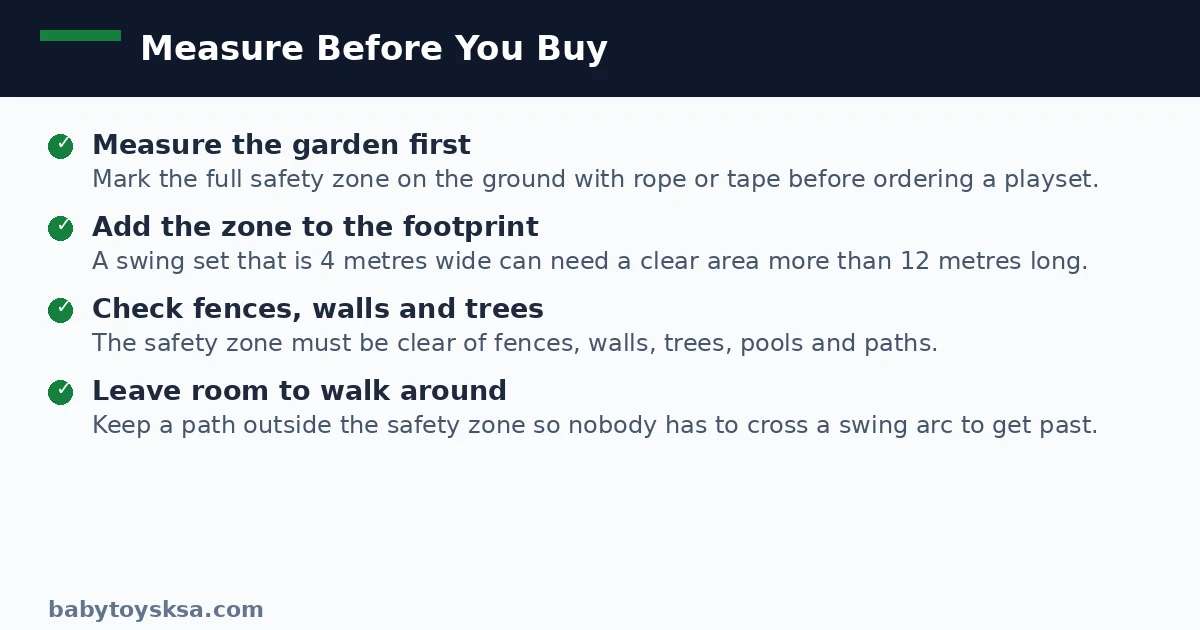
Many Saudi villa gardens are not huge, and that does not mean children cannot have a swing set. It means you must choose the set for the space, not the other way round. Start by measuring the garden properly, including the fences, walls, trees, air conditioning units, water tanks and any fixed features. Then mark out the full safety zone for each set you are considering, using rope, tape or garden hose laid on the ground. Walk around inside the marked zone and imagine a child falling, jumping or running through it. If anything hard sits inside the marks, the set does not fit there.
If the garden is tight, choose a set that shares its zones well. A swing set with a slide attached, such as our swing set with yellow slide and blue frame, which measures 400 by 280 by 260 cm, at 2800 SAR, puts the slide and the swings in one structure, so you plan one zone instead of two. A compact slide on its own, such as our metal slide in silver and green, which measures 250 by 140 cm, at 450 SAR, needs only its own 6 feet zone and a clear exit, and it fits gardens where a full tower set would not. In fact, a seesaw or a roundabout needs less space still, but each still needs its own clear area, and their zones must not overlap the swing zone.
Plan the Surfacing With the Distances
Also plan the surfacing at the same time as the distances, because the zone and the surfacing go together. Cover the whole safety zone, not just the ground under the equipment, with impact absorbing surfacing, such as rubber tiles, poured rubber, or a deep layer of loose fill. Hard ground inside the zone defeats the purpose of the zone. Our guide on playground safety flooring explains the options for Saudi gardens. And remember that the zone must stay clear for the life of the set. Do not let a plant pot, a bicycle, a storage box or a new air conditioning unit creep into it later. In short, a safety zone that fills up with clutter is no longer a safety zone.
Common Space Planning Mistakes to Avoid
The most common mistake is measuring the frame instead of the zone. A family measures the garden, finds the frame fits with a metre to spare, and orders the set, only to discover on installation day that the safety zone runs into the fence. Always measure the zone first, and treat the frame size as the smaller number. The second mistake is forgetting the height. A taller set needs a bigger zone, so a tower playset that looks like it fits on the ground may still need more space than the garden has once you count the fall height. Check the height of the set, not just its length and width.
The third mistake is putting the slide exit or the swing arc facing a path, a gate or a pool. Children run to the slide and to the swings, and they do not look where they are going. A slide that exits onto a path means a sliding child and a walking adult meet at speed. A swing bay that faces the garden gate means a child can run into the swing arc from outside. Plan the layout so the busy routes run around the play area, not through it. The fourth mistake is placing two pieces of equipment so their zones overlap. Two sets side by side may look tidy, but if a child can fall from one into the path of the other, the layout is wrong. Keep zones separate, even if it means choosing one good set instead of two crowded ones.
Do Not Forget the Adults
Finally, do not forget the adults. You need space to stand beside the set, to supervise, to push a swing, and to reach a child quickly. Leave a clear walkway around the outside of the safety zone, and make sure you can see the whole play area from where you usually sit. If you are planning a play area for a school or a compound, the same rules apply at a larger scale, and our team can help you plan a layout that keeps every zone clear. In the end, when the planning is done properly, the garden feels bigger, not smaller, because every piece of equipment has the space it needs and children can play freely without running into trouble.