

Playground Supervision Rules Every Parent Should Know
The Short Version: Supervise actively from a spot where you can see the whole playset and reach any child in seconds. Watch toddlers within arm’s reach, watch young children closely, and stay alert with older children too. Check the equipment before play, agree who is watching, and keep your attention on the children, not your phone.
Quick Answer: The main playground supervision rules are simple: an adult should watch children actively at all times, from a place where the whole play area is visible, close enough to reach a child quickly. Toddlers aged 1 to 3 need an adult within arm’s reach, children aged 4 to 7 need close watching, and older children aged 8 to 12 still need an alert adult nearby. Check the equipment for hot surfaces, damage and loose parts before play starts.
Why Playground Supervision Rules Matter More Than Any Equipment Feature
A well built playset, soft surfacing and a proper safety zone all matter, but none of them replaces an adult who is watching. Most playground injuries happen quickly, in a few seconds, and the difference between a scare and a serious injury is often whether an adult saw it happening and was close enough to help. A child can slip from a platform, run into the path of a swing, or climb somewhere they should not be in less time than it takes to read a message. In short, that is why supervision is the first safety rule, before any check of bolts or surfacing, and why this guide treats watching as a skill you can learn, not just a presence you provide.
Active supervision is different from simply being in the garden. Sitting nearby with your eyes on a phone, chatting with a neighbour with your back to the playset, or watching from inside the house through a window are all common, and none of them is active supervision. An actively supervising adult can see every child, knows where each one is, notices risky behaviour early, and can reach the playset in seconds. That sounds demanding, and for toddlers it is, but it becomes a habit quickly, and it is the habit that keeps outdoor play safe and fun. The World Health Organization recommends that children aged 5 to 17 average at least 60 minutes of moderate to vigorous physical activity a day, and outdoor play on a swing set or slide is one of the best ways to get it. In fact, good supervision does not reduce that play. It makes it possible, because children play more freely when an adult they trust is watching.
What This Guide Covers
This guide sets out the playground supervision rules every parent should know, for a home garden in Saudi Arabia. It covers where to stand, how supervision changes with age, how to handle mixed ages, what to check before play, and what to do when something goes wrong. Finally, it applies whether your children are playing on a small swing set or a large tower playset, at home, at school or in a compound.
Playground Supervision Rules: Where to Stand and How to Watch
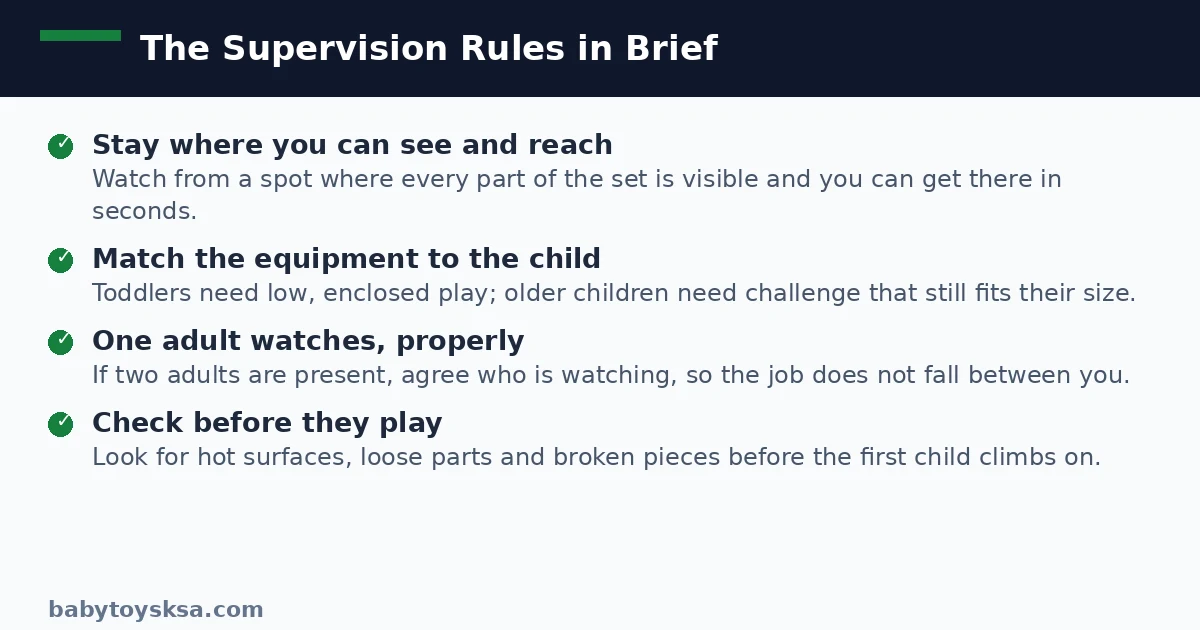
The first rule is position. Stand or sit where you can see the whole playset, including the slide exit, the swing arc, the climbing side and the platform, without turning your head away from any part of it. If a wall, a tree or the playset itself blocks your view of one corner, move, because the corner you cannot see is where trouble happens. Stay close enough to reach any child in a few seconds. For toddlers that means within arm’s reach. For older children it means close enough to get there before a fall becomes a second fall, or before a child who is stuck panics.
The second rule is attention. Watching means watching, not glancing up between other things. Put the phone away, or at least keep it in your pocket. If you need to take a call, step in close to the children first, or ask another adult to watch while you do. Talk with other adults, by all means, but face the playset while you do it, and keep your eyes moving between the children. Experienced parents scan. They look at each child in turn, check what each one is doing, and look again. In fact, that scan takes seconds, and it catches the child who has climbed too high, the one who is standing on a swing seat, and the one who is running towards the swing arc before any of them gets hurt.
The Third Rule: Agree Who Is Watching
The third rule is agreement. When two or more adults are present, agree out loud who is watching. Say it plainly, such as I am watching the children, you go inside. Without that agreement, each adult assumes the other is watching, and nobody is. This is one of the most common supervision failures, and it happens in the safest families. The same applies with older siblings. A twelve year old is not a supervisor, however responsible they seem. Finally, they can help, they can play with younger children, but the responsibility for watching stays with an adult.
Supervision by Age: Toddlers Aged 1 to 3
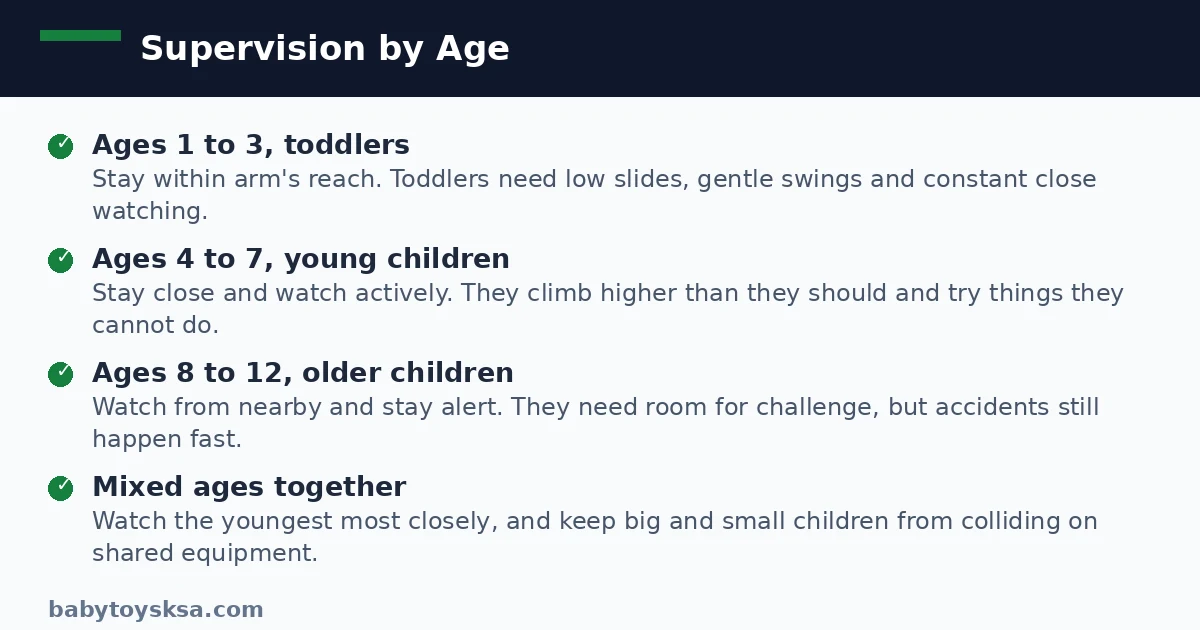
Toddlers need the closest supervision of any age group. Children aged 1 to 3 are still learning balance, they do not judge height or speed, they put everything in their mouths, and they can get into trouble silently and fast. An adult should stay within arm’s reach of a toddler on play equipment, ready to catch, steady or lift them at any moment. That means standing beside the slide, not watching from a chair across the garden, and holding a toddler on a swing rather than pushing from a distance.
Choose equipment that fits a toddler. Low slides with gentle slopes, bucket swings with leg holes and a high back, and low platforms they can climb onto without help are right for this age. A tall slide, a belt swing or a high platform is not a toddler toy, however much the child wants to try it. If an older sibling is playing on the tall equipment, keep the toddler on their own low equipment, and watch the boundary between the two, because toddlers wander towards the exciting big equipment without understanding the danger. In fact, our indoor red slide and swing set, which measures 395 by 370 by 270 cm, at 2800 SAR, suits families who want a contained play space, and its lower slide is a good first slide for a small child under close supervision.
Watch the Small Dangers Too
Also watch the small dangers. Toddlers trip on the edge of surfacing, catch fingers in chains and joints, and try to climb the outside of equipment. Check the ground for small stones, toys and anything a toddler could choke on before they play. Keep drinks and snacks away from the playset, and never leave a toddler alone on equipment, even for a moment, even to answer the door. In short, a toddler can fall from a low platform in the seconds you are gone.
Supervision by Age: Children Aged 4 to 7 and 8 to 12
Children aged 4 to 7 are the busiest and the boldest on a playset. They climb, they swing high, they race each other, and they try things they have seen older children do. Close, active watching is what they need, from a spot where you can see them and reach them quickly. They also need rules they understand. Teach them the basic rules before they play, such as one child on the slide at a time, no standing on swing seats, no climbing up the slide, and no walking in front of or behind a moving swing. Repeat the rules often, and enforce them kindly but firmly. In fact, children this age test rules, and a rule that is never enforced is a rule they will ignore.
Children aged 8 to 12 need a different kind of supervision. They are stronger, faster and more capable, and they need challenge to stay interested in outdoor play. Let them climb higher, swing higher and play more freely, but stay alert and stay nearby. Accidents at this age often come from showing off, from dares, and from several children using one piece of equipment at once. Watch for overcrowding on platforms, for children pushing each other on swings, and for games that turn rough. Finally, you do not need to hover over an eleven year old, but you do need to be present, visible and paying attention, and the child should know you are there.
Mixed Ages Need the Most Careful Watching
Mixed ages need the most careful watching of all. When toddlers, young children and older children share one playset, the biggest risk is collision, an older child swinging or sliding into a smaller one who has wandered into the way. If you have children of very different ages, consider separate play times, or separate areas, with the younger children on low equipment while the older ones use the tower or the swings. A round merry go round with a blue circular bench, which measures 140 by 100 by 90 cm, at 550 SAR, is a gentle shared toy that suits mixed ages, but even there an adult should watch the speed and who is getting on and off.
Playground Supervision Rules Before Play Starts
Supervision starts before the first child climbs on. Walk the playset quickly and check the things that change day to day. In Saudi summer, touch every slide, seat and metal surface with the back of your hand before a child touches it. Metal and dark plastic in direct sun can get hot enough to burn, and a slide that was fine in the morning can be too hot by the afternoon. If a surface is too hot for your hand, it is too hot for a child, so shade it, cool it with water, or wait until evening. Also check for anything that appeared overnight, such as a wasp nest, an animal, a broken branch, or a toy left on a platform.
Check the equipment itself, quickly, every time. Look for a bolt that has worked loose, a swing seat that is cracked, a chain that is twisted, or surfacing that has shifted away from under the swings. Our guide on checking a playset for rust, cracks and loose bolts covers the full monthly inspection, but the daily check is a two minute look that catches the obvious problems. Also check the ground. After rain or watering, surfacing can be slippery, and loose fill can wash away from under the swings, leaving hard ground where children land. Finally, rake it back, or keep children off that part until you fix it.
Set the Rules Before Play, Not During It
Set the rules before play, not during it. Tell the children how many can use each part at once, which direction to go on the slide, and where not to walk. Make the rules short and clear, and make them the same every time, so they become habit. Tell children what to do if something hurts, if they feel scared, or if a part breaks. They should come to you, not try to fix it themselves. And set a time limit in hot weather. Children do not always notice heat and thirst while they are playing, so bring water out, offer it often, and bring them inside before the hottest part of the day.
What to Do When Something Goes Wrong
Even with good supervision, falls happen, and knowing what to do in the first minute matters. If a child falls, stay calm and go to them. Do not move a child who is not moving, who is crying in a way that sounds different, or who says their neck, back or head hurts. Call for help and keep them still. For a small bump or scrape, clean the wound, apply pressure if it bleeds, and comfort the child. Keep a small first aid kit near the garden door, with plasters, antiseptic, gauze and a cold pack, so you are not searching the house while a child is upset.
If a piece of equipment breaks while a child is on it, get the child off safely first, then keep everyone off that part until you repair it. Do not let children keep playing on a broken swing or a cracked slide while you decide what to do. Take a photo of the damage, note what happened, and check whether a part needs replacing. Our team can help with spare parts and repairs, and you can reach us on WhatsApp at +966554340714. If a child is hurt badly, or you are unsure how badly, seek medical help at once, and do not wait to see if it gets better. It is always better to have a doctor say a child is fine than to wish you had gone sooner.
After an Incident, Ask What Caused It
After an incident, however small, ask what happened and what could prevent it next time. Did a child run into the swing zone because the path crosses it? Could two children have crowded onto a platform that fits one? Or had a bolt loosened because it had not been checked? In fact, most playground accidents have a cause you can fix, and fixing it is part of supervision. Talk about it with the children too, without blame, so they learn to spot danger themselves. Good supervision is not just watching. It is teaching children, little by little, to play safely on their own.
Making Supervision Easy in a Saudi Family Garden
Supervision is easier when you set the garden up for it. Place the playset where you can see it from the shaded seating area, the kitchen window or the majlis, so watching is comfortable rather than a chore. Keep the seating close enough to reach the set quickly, but outside the safety zone, so you are not standing in the path of a swing. Keep the play area tidy, with toys put away and paths clear, so you can see the ground and the children clearly. If the garden is large, consider a play area in one defined space rather than equipment scattered across the garden, so all the children are in one place you can watch.
Plan for the heat, because supervision in Saudi summer is physically hard. Set up shade for the adults as well as the children, keep cold water nearby, and schedule play for the cooler hours, early morning and late afternoon, rather than midday. If the family has a helper or a relative watching the children, make sure they know the same rules, and agree who is responsible at each time of day. A helper who knows the rules is a good supervisor. In short, a helper who has never heard the rules is not.
Supervision Is Part of the Fun
Finally, remember that supervision is part of the fun, not a punishment. Children play more confidently when an adult is watching with interest, cheering them on, pushing a swing, or joining a game. The best playground supervision rules are not a list of things you cannot do. They are a way of being present, so that outdoor play stays what it should be, active, joyful and safe. If you are choosing a playset for your family, think about supervision as part of the choice. A set that fits your garden, suits your children’s ages, and sits where you can watch it easily gets used more and enjoyed more than a bigger set hidden in a corner. You can browse our swings and slides collection and our large playsets and towers range, and our team will help you plan a play area that works for your family.