

Playground Safety Checklist: 15 Checks Before Your Kids Play
A playground safety checklist is the simplest habit a parent can build around a garden playset. Children play hard, and most garden play injuries come from falls, loose parts or equipment that has quietly worn out in the sun. The World Health Organization recommends that children aged 5 to 17 get an average of at least 60 minutes of moderate to vigorous physical activity a day, and a safe garden playset is one of the easiest ways to make that happen at home. For example, this playground safety checklist gives you 15 checks you can run in about five minutes, before your kids play, so the fun stays safe. It works for a small swing set or a large tower playset, and it suits Saudi gardens, where sun, dust and heat wear equipment faster than many parents expect. BabyToysKSA supplies and installs home, garden and game toys across Saudi Arabia, and every check below is something our installation teams look at on real jobs in Riyadh, Jeddah and Makkah.
The Short Version
A playground safety checklist takes five minutes and can prevent most common garden play injuries. Walk the play area, check the surface, test every bolt and swing, and only then let the children play.
Quick Answer
The quick answer: check the surfacing depth, the anchoring, every bolt and chain, the slide and swing condition, the space around the equipment, the heat of metal parts, and that an adult is watching. If anything fails, fix it before play starts.
Why a Playground Safety Checklist Matters
A playset looks fine from the kitchen window. Up close, a bolt can be loose, a swing chain can be worn thin, or the sand under the slide can have blown away until bare concrete shows through. Falls cause most playground injuries, and the United States Consumer Product Safety Commission notes that about 80 percent of playground injuries happen when children fall from equipment. In short, a checklist turns a quick glance into a real inspection, and it catches small problems while they are still cheap and easy to fix.
In Saudi Arabia there is an extra reason to check often. Summer sun heats metal parts, dust and sandstorms grind moving parts, and coastal air in Jeddah speeds up rust on bare steel. A set that was perfect in winter can be a different set by August. In fact, running this playground safety checklist once a week, and once before any play session after a storm or a long break, keeps surprises away.
How to Use This Playground Safety Checklist
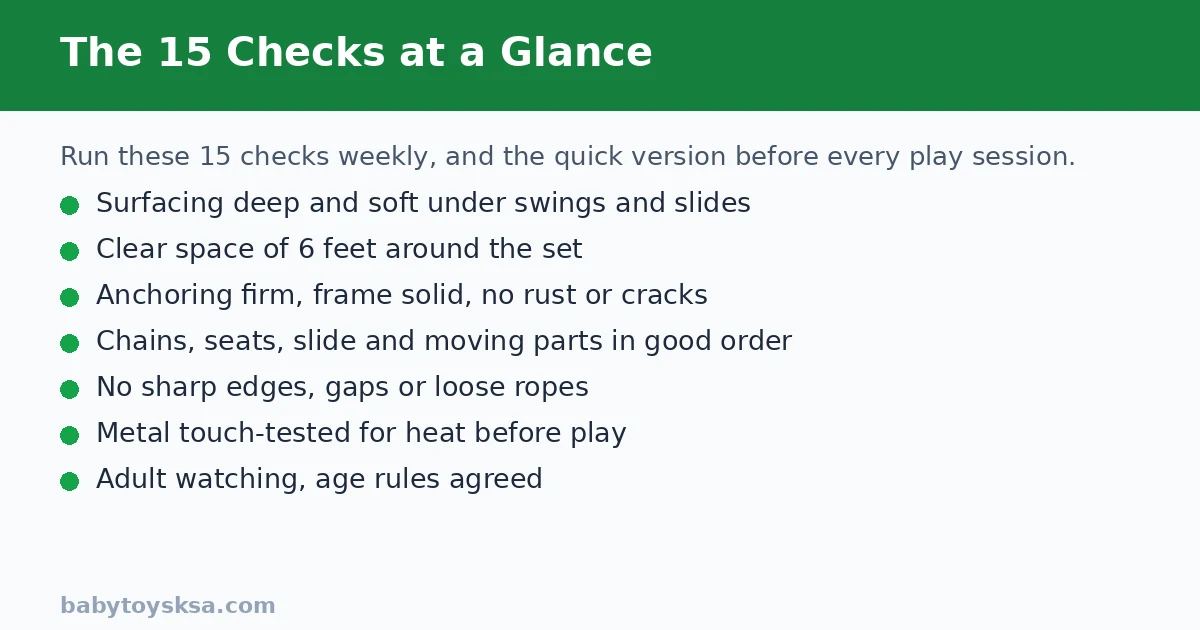
Print this page or save it on your phone. Walk slowly around the playset in the same order every time, and check each item off as you go. If a check fails, stop play on that piece of equipment until it is fixed. A failed check on the slide does not mean the seesaw is unsafe, but a failed check on the frame or the anchoring means the whole set stays off limits until someone repairs it. Finally, keep a small notebook or phone note with the date of each check, so you can see which parts wear out fastest in your garden.
Checks 1 to 3: The Ground and the Space Around the Playset
Check 1: Look at the surfacing under and around the equipment. There should be soft, impact-absorbing material under every swing, slide and climbing point, and it should be deep enough to cushion a fall. Bare concrete, tiles, paving or compacted earth under a swing or slide is a fail. The United States Consumer Product Safety Commission guidance for loose-fill surfacing gives minimum compressed depths of 9 inches for sand, pea gravel and wood mulch, and 6 inches for shredded or recycled rubber, with deeper material needed for higher equipment. Finally, top up loose material whenever it thins out, because children kick it away from the landing spots first.
Check 2: Measure the clear space around the set. Play equipment should sit at least 6 feet from any wall, fence, tree, shed or other obstacle, and swings need extra clear space in front and behind, because a swinging child travels forward and back. In short, move garden furniture, plant pots, bicycles and tools out of that zone before play starts.
Check 3: Check the ground is level and firm. A playset on a slope can tip, and soft ground after watering or rain lets legs sink unevenly, which twists the frame. For example, if a leg has sunk or the frame rocks when you push it, level the ground and re-check the anchoring before anyone climbs on.
Checks 4 to 6: Anchoring and the Frame
Check 4: Test the anchoring. Push the frame firmly from several directions. It should not lift, slide or rock. Every leg of a swing set needs anchoring to the ground, and the anchors or concrete footings should sit below ground level and under the surfacing, not sticking up where a child can trip on them. In fact, anchoring is so important that it has its own guide on this site, and you can read it in our professional installation service before you install or re-anchor a set.
Check 5: Inspect the frame for cracks, bends and rust. Look closely at welds, joints and anywhere two parts meet. You can clean and paint surface rust, but deep rust, a cracked weld or a bent leg means someone should repair or replace the part before use. For example, coastal homes in Jeddah should check for rust more often, because salt air speeds it up.
Check 6: Shake every joint. Grab each upright and crossbar and try to move it. Nothing should wobble. Tighten any bolt that has worked loose, and replace bolts that are bent, rusted through or missing their nuts. Finally, a bolt that keeps coming loose is telling you the hole has worn larger, and that joint needs a proper repair, not just another turn of the spanner.
Checks 7 to 9: Swings, Slides and Moving Parts
Check 7: Inspect swing chains, ropes and seats. Look for worn links, frayed rope, cracked plastic seats and rusted S-hooks. S-hooks should be fully closed, with no gap a chain link or a small finger can slip through. In short, replace a worn chain before it breaks, because a chain usually fails while a child is swinging at full height.
Check 8: Check the slide from top to bottom. The slide bed should be smooth, with no cracks, sharp edges, raised screws or peeling coating. The top platform needs its guardrails in place, and the ladder rungs should be firm and evenly spaced. For example, a cracked plastic slide can cut skin and can also snap under weight, so take a cracked slide out of use until someone replaces it.
Check 9: Test every moving part. Seesaws should move smoothly without sticking or slamming, merry-go-rounds should spin freely and stop without grinding, and swing seats should hang level. Listen for grinding, squeaking or clicking, which usually means a bearing or a bolt needs attention. Finally, our red and yellow seesaw and blue round merry-go-round are good examples of simple moving toys that still need this check, because their moving parts take the most wear.
Checks 10 to 12: Small Hazards Children Miss
Check 10: Look for sharp points, open bolt ends and splinters. Run your hand carefully along handrails, ladder rungs and platform edges. Cap any bolt end that sticks out, and file any sharp edge smooth or cover it. Check wooden parts for splinters and metal parts for flaking paint or rust flakes.
Check 11: Check for entrapment gaps. Openings in guardrails, between ladder rungs and between platform bars should not be wide enough for a child’s head to pass through and get stuck, and not so narrow that a small hand or foot wedges in. In fact, if you are unsure about a gap, measure it and ask your installer, because entrapment is one of the hazards the European EN 1176 playground standard guards against.
Check 12: Clear the play area of dangerous extras. Remove ropes, skipping ropes, dog leads, scarves and drawstrings from the playset, because anything that can loop around a neck is a strangulation risk. Then remove broken toys, glass, stones and animal waste from the surfacing, and check that no wasp nest or ant nest has appeared in or under the equipment.
Checks 13 to 15: Heat, Weather and Supervision
Check 13: Touch-test every metal surface before play. In a Saudi summer, a metal slide, handrail or swing chain in direct sun can get hot enough to burn skin in seconds, and surfaces can sit far hotter than the air temperature. Press the back of your hand on the slide bed, the handrails and the swing seats. If it is too hot to hold comfortably, the equipment is too hot to play on until it cools or shade covers it. Finally, play early in the morning or late in the afternoon in summer, and keep the set shaded wherever possible.
Check 14: Check the weather and the condition after wind or dust. After a sandstorm or strong wind, check that the anchoring is still firm, that no branch or debris has fallen on the set, and that loose surfacing has not blown away from the landing zones. In winter rain, check that water is not pooling under the equipment and making the ground soft.
Check 15: Set the supervision and age rules before play starts. Match each child to equipment made for their age and size, with toddlers aged 1 to 3 on low, simple equipment and older children on bigger sets. Agree the rules out loud: one child on a swing seat, no standing on swings, no climbing up the slide, no pushing. An adult should be able to see the whole playset from where they sit, and younger children should never play unsupervised.
What to Do When a Check Fails
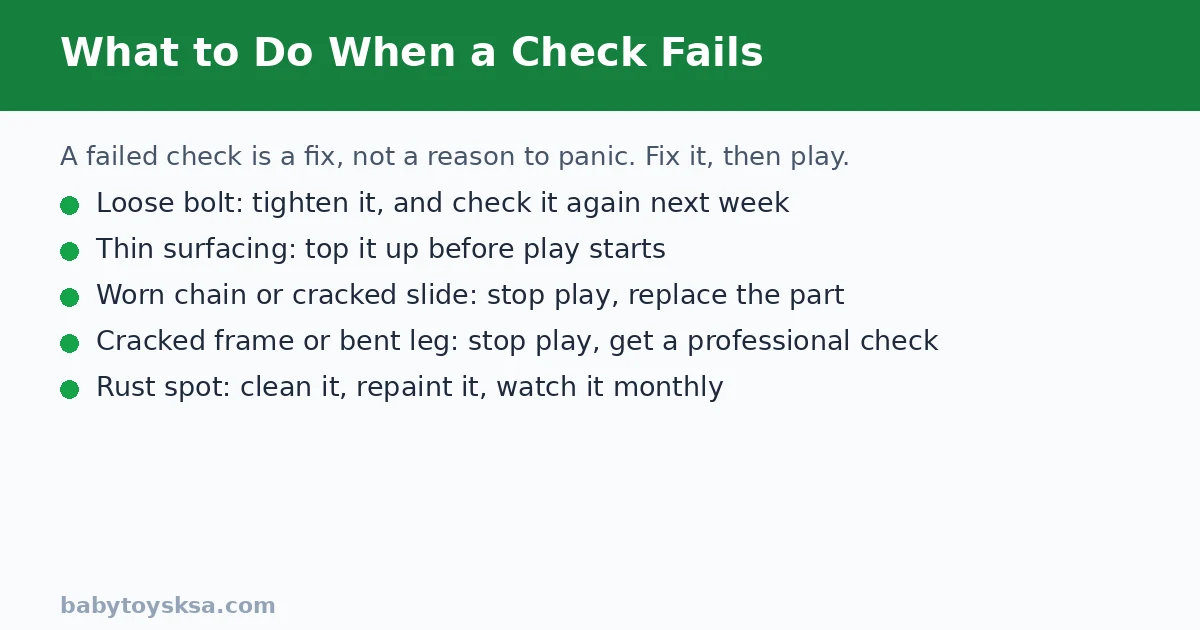
A failed check is not a reason to throw the whole playset away. Most failures have a simple fix: top up the surfacing, tighten the bolts, replace a worn chain, repaint a rust spot, or re-anchor a leg. The right response depends on the failure. A loose bolt is a ten-minute job. A cracked frame, a bent leg or a broken weld is a stop-play job until someone replaces the part. If you are not sure whether a repair is safe, ask the supplier or installer before letting children back on. BabyToysKSA installs playsets across Saudi Arabia, and our installation service includes checking anchoring and fixings as part of the job, so a professional eye is available if a problem looks bigger than a simple fix.
Keep spare parts simple: a small box with the right size bolts, S-hooks, caps and a tin of touch-up paint saves a weekend. In short, write down which parts you replace and when, because a part that fails twice is a sign of a deeper problem, such as a frame that is twisting or a joint that is taking more load than it should.
Choosing Equipment That Is Easier to Keep Safe
Safety starts at the buying stage. A well-built set with a sturdy frame, smooth welds, capped bolts and coated metal parts is easier to keep safe than a cheap set that rusts and loosens in its first summer. Look for powder-coated galvanized steel frames and UV-stabilised plastic parts, which stand up better to Saudi sun, dust and coastal air. Think about size as well: a set that fits your garden with clear space around it is safer than a bigger set squeezed against a wall.
For a small garden, the single green slide with metal frame at 220 by 140 centimetres and 1,200 SAR is a compact starting point that is easy to inspect and easy to keep clear. Families who want swings as well often choose the swing set with yellow slide and blue frame at 400 by 280 by 260 centimetres and 2,800 SAR, or the two-seat swing set with blue and red frame at 200 by 120 by 210 centimetres and 750 SAR. Larger gardens suit a tower such as the tower playset with red double slide, swings and blue roof at 340 by 280 by 290 centimetres and 3,300 SAR. Every price here comes from the BabyToysKSA product catalogue, and the descriptive names describe the photo, not a supplier model name.
If you are still choosing, our Design Finder tool helps you match a playset to your garden size, and our large playsets and towers and swings and slides collections show the full range. In short, a set chosen for the right space is a set you can inspect properly, and that is half of safety.
A Simple Weekly and Monthly Routine
Daily, before play: run the five-minute version. Touch-test hot metal, glance at the surfacing under the swings and slide, check that nothing has blown into the play area, and confirm an adult is watching. Weekly: run all 15 checks, tighten anything loose, and top up surfacing. Monthly: look harder at welds, chains and anchor points, clean the equipment, and check for rust after rain or coastal humidity. After any storm, high wind or long holiday away from home, run the full 15 checks again before the first play session.
Keep the routine light enough that you actually do it. You will skip a checklist that takes an hour. A five-minute walk with a phone note, done the same way every time, becomes a habit, and habits are what keep children safe. Finally, teach older children the first three checks as well, so they learn to look at the slide and the swings before they climb on, and to tell an adult when something looks wrong.
Frequently Asked Questions
How often should I run a playground safety checklist?
Run the quick five-minute version before every play session in summer, and the full 15 checks at least once a week. Always run the full checklist after a storm, after a long break, and after any repair or new installation.
What is the most common playground safety failure at home?
Thin or missing surfacing under swings and slides is the most common failure, because loose material gets kicked away and blown by wind. Check the depth under the landing spots first, and top it up before you check anything else.
Can I use my playset if one check fails?
It depends on the check. A failed surfacing, anchoring, frame or chain check means stop play on that piece until someone fixes it. A cosmetic issue such as faded paint can wait, but anything structural, anything that moves, and anything hot should stop play first.
Does a home playset need the same checks as a school playground?
The checks are the same in principle, but a school playground follows formal inspections under standards such as EN 1176, with routine, operational and annual inspections. At home, your weekly checklist is the inspection, so do it properly and keep a note of the dates.
Who can I ask if I am not sure a repair is safe?
Ask the supplier or the installer who fitted the set. If you bought from BabyToysKSA, contact us on WhatsApp at +966554340714 or by email at Waqaryounishr23@gmail.com and describe the problem, with a photo if you can. Never guess on a structural repair.
A playground safety checklist is not paperwork. It is five minutes that stands between your children and the most common garden play injuries. In short, run the 15 checks, fix what fails, and keep the routine going through the Saudi summer and beyond. If you are planning a new playset, or an old set needs a professional check, browse the BabyToysKSA shop, try the Design Finder, or message us on WhatsApp at +966554340714. Safe play is happy play, and it starts before the first swing.