

How to Check a Playset for Rust, Cracks and Loose Bolts
The Short Version: Walk around the playset once a month, look at every joint, feel every slide and rail, shake every frame, and check the ground underneath. Clean light surface rust, tighten loose bolts, and replace any part that is cracked, deeply rusted or will not stay tight.
Quick Answer: To check playset rust, cracks and loose bolts, inspect all metal joints for orange rust, run your hand over plastic parts for cracks and sharp edges, test every bolt with a spanner, and push each frame to check for wobble. Do this monthly, and after every dust storm, heavy rain or long hot spell.
Why You Should Check Playset Rust, Cracks and Loose Bolts Every Month
A garden playset looks solid from the kitchen window, but the parts that fail are the ones you cannot see from a distance. A bolt works loose a quarter turn at a time, rust grows under a paint chip, and a hairline crack in a plastic slide widens a little more every hot afternoon. None of these problems announces itself. They build quietly until a swing seat drops, a rail gives way, or a child catches a hand on a sharp edge. In fact, a monthly check takes about twenty minutes, costs nothing, and catches almost every problem while it is still small and cheap to fix.
Saudi gardens are harder on play equipment than gardens in milder climates. Summer heat expands metal and plastic during the day and lets them shrink at night, which slowly works fasteners loose. Dust gets into joints and holds moisture against the metal after rain or washing. In coastal cities such as Jeddah, salt in the air speeds up rust on any bare steel. Even in Riyadh, where the air is dry, dust storms blast fine sand against paint and coatings, wearing them thin. In short, a playset that would last years with little attention in a mild climate needs a regular look in Saudi Arabia, and the owner who checks monthly is the owner whose playset lasts.
What This Guide Covers
This guide shows you exactly how to check playset rust, cracks and loose bolts on a home garden playset, step by step, with no special tools beyond a spanner, a screwdriver and a cloth. It covers what to look for on metal frames, plastic slides, swing seats and chains, wooden parts if your set has any, and the ground underneath. It also explains what to do with each problem you find, from a five minute clean and tighten to the point where you must replace a part. Finally, if you bought your set from BabyToysKSA, our installation team can help with spare parts and repairs, and you can reach us on WhatsApp at +966554340714.
How to Check Playset Rust, Cracks and Loose Bolts: Step by Step
Start with a slow walk around the whole playset before you touch anything. Look at the overall shape first. Does the frame stand straight, or does one side lean? Are all four legs, or all the feet of a tower set, sitting firmly on the ground? A lean or a sinking leg is often the first sign that a joint has loosened or the ground has shifted underneath. Look at the ground itself too. If the soil or surfacing has washed away from under a leg, the frame will rock, and rocking works bolts loose faster. Finally, note anything that looks different from installation day, and take a photo of anything you are unsure about so you can compare it next month.
Next, work through the frame joint by joint, starting at the top and moving down. Every place where two tubes meet, every bracket, every bolt head and nut gets a look and a touch. Surface rust shows as orange or brown dust or small blisters under the paint. Run a finger over it. If the surface still feels smooth and solid underneath, it is early rust and you can clean it. If the metal feels rough, pitted or flaky, or if you can press a screwdriver tip into it, the rust has gone deeper and that part needs a closer look. Finally, pay special attention to joints near the ground, where water and dust collect, and to any spot where the paint has chipped, because bare metal rusts first.
Testing Every Bolt and Nut
Now test every bolt and nut with a spanner or socket. Do not just look at them. A bolt can look tight and still turn half a rotation before it bites, and that half turn is the difference between a solid joint and a wobbly one. Tighten each fastener gently until it is snug, and do not force it past that point, because over tightening can strip the thread or crack a plastic bracket. If a bolt turns freely without ever getting tight, the thread or the hole is worn and you should replace the bolt rather than tightening it again. Check that every bolt has its nut and washer. In fact, a missing nut is easy to miss, and a joint held by one bolt instead of two is a joint waiting to fail.

Checking Slides, Platforms and Plastic Parts for Cracks
Plastic parts fail differently from metal. They rarely rust, but they crack, fade and turn brittle, and Saudi sun speeds up that process. Run the palm of your hand slowly along every slide, rail, roof panel and step. Your hand will find a crack, a rough patch or a sharp edge that your eyes miss, especially on a brightly coloured slide in strong sunlight. Look closely at the places where plastic meets metal, because screws and bolts can stress the plastic around them and start small star shaped cracks. Check the top of the slide where children sit down, the edges of platforms, and the underside of roofs, where heat collects.
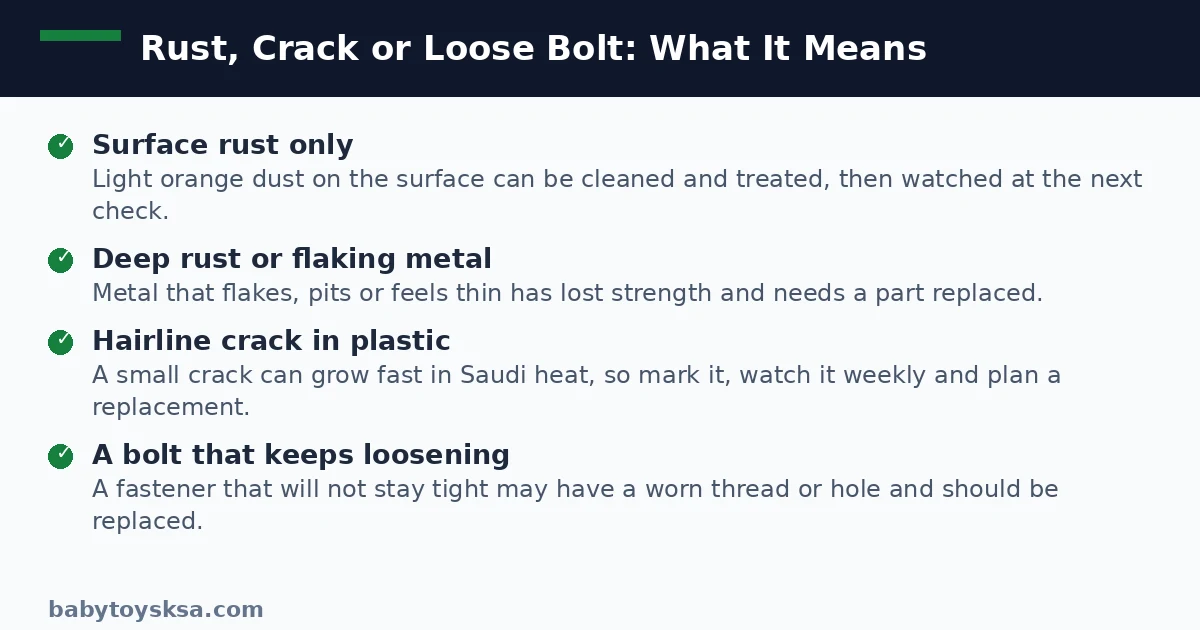
A hairline crack is a thin dark line, often no wider than a thread. Mark both ends of it with a small piece of tape or a pencil mark, and check it again in a week. If the line has grown past your marks, the crack is spreading and you should replace the part soon, before it becomes a sharp edge or a break. A crack that you can fit a fingernail into, or one that runs across a slide or a step where a child puts weight, is already serious. In short, do not let children use that part until you replace it. Faded or chalky plastic is a warning sign too. When the colour has bleached and the surface feels dry and powdery, the material is losing strength, even if no crack is visible yet.
Swing Seats, Chains and Ropes
Also look at swing seats, chains, ropes and connectors. Swing seats crack around the bolt holes first, so check those corners carefully. Chains should hang straight with no twisted or stretched links, and the connectors at the top and bottom should close fully. A connector that has opened up, even slightly, can slip off under load. Ropes fray from the inside out, so squeeze them and look for thin or fuzzy sections. Take any swing part that is cracked, stretched, frayed or bent out of use until you replace it. In fact, a spare swing seat or chain is inexpensive compared with a fall.
Checking the Frame, Legs and Anchors
The frame carries everything, so give it a firm push test. Stand beside the playset and push each upright and each swing bay sideways, then pull it towards you. A well installed frame should feel solid, with no visible movement at the joints and no rocking at the feet. A small amount of flex is normal on a tall swing frame, but a clunk, a knock or a visible shift at a joint means a bolt is loose or a bracket is worn. Check the swing bay separately from the tower or slide section, because the swing bay takes the hardest repeated loads. Finally, if the whole set rocks, check the anchors or ground fixings first.
Look at the feet and the ground fixings. Many home playsets sit on flat feet, while larger sets have anchors in the ground or concrete footings. Check that each foot sits flat and level, and that no foot has sunk into soft soil after rain or watering. If your set has anchors, look at the anchor points for rust, cracked concrete or loose bolts. Grass and soil can hide the base of a leg, so pull the grass back and look. A leg buried in damp soil will rust faster than a leg that can dry out, so keep soil and mulch away from the metal and leave a small gap so air can reach it. Finally, if you are unsure whether the anchors on your set are sound, our team at BabyToysKSA can check the installation, and you can see how our sets are built on the large playsets and towers page.
Wooden Parts Need a Hand Check Too
Also check any wooden parts, such as a wooden platform, a roof frame or decorative toppers. Wood in a Saudi garden dries, shrinks and splits, and splinters are the most common minor injury on wooden equipment. Run your hand along every wooden edge and look for splits, especially at screw holes and at the ends of boards. You can sand and seal a split that runs along a board, but replace a board that is cracked right through. Keep wood out of contact with damp soil, and re seal any bare wood you find so it does not soak up water when you water the garden.
Check Playset Rust, Cracks and Loose Bolts After Storms, Heat and Long Breaks
A monthly check is the baseline, but some moments call for an extra inspection. After a dust storm, check every joint and bolt, because fine sand works its way into threads and joints and grinds away at coatings. When it rains, look for water sitting in cups, joints and slide hollows, and wipe it away so it does not sit against the metal. And after a long hot spell, check plastic parts for new cracks and check bolts again, because heat expansion and contraction loosen fasteners. And after a long break, such as a summer holiday away from home or a winter when the children played inside, inspect the whole set before the children go back on it. In fact, a set that has stood unused for weeks can hide a problem that developed while nobody was looking.
Coastal homes need extra attention. In Jeddah and other coastal areas, salt air attacks bare metal quickly, and rust can appear on a chipped spot within weeks rather than months. If you live near the coast, wipe the frame down after dust storms, keep paint chips touched up, and check ground level joints every two weeks during the humid season. Inland homes in Riyadh and Makkah face more dust and more extreme heat, so the checks there should focus on plastic cracking and bolt loosening. Wherever you live in Saudi Arabia, the rule is the same. The harder the weather, the more often you should look. In short, a quick five minute look every week, plus the full monthly check in this guide, is enough for most home playsets.
What to Do With Each Problem You Find
Light surface rust is the easiest problem to fix. Rub the spot with a wire brush or coarse cloth until the orange dust is gone and the metal underneath looks clean. Wipe it with a dry cloth, then cover it with a rust stopping primer and a matching touch up paint. Let it dry fully before children use the set. This is a thirty minute job that can add years to a frame. Deep rust is different. If the metal is pitted, flaking or thin enough to dent with a thumb, cleaning and painting will not restore its strength. Replace that part, and keep children off the playset until you do. Never paint over deep rust and call it fixed. In fact, paint hides the problem while the metal keeps weakening underneath.
A loose bolt usually just needs tightening, but a bolt that keeps coming loose needs a replacement. First check whether the nut, washer and bolt all match and are the right size. A wrong size nut will never hold. If the thread is stripped, replace the bolt and the nut together. If the hole in the frame has worn larger, a slightly larger bolt or a repair washer may help, but if the frame hole is badly worn, that section of frame needs replacing. Keep a small bag of spare bolts, nuts and washers that match your set, so a loose fastener never waits a week for a spare. When you buy spare parts, bring the old bolt with you or send us a photo, so the replacement matches exactly.
Cracked Plastic and Structural Damage
Replace cracked plastic parts, do not glue them. Glue does not restore the strength of a slide or a step, and a glued crack can fail without warning under a child. Order the replacement part, remove the cracked part so nobody can use it, and fit the new part before the children play again. If a swing seat, chain or rope is worn, replace it the same way. For anything structural, such as a cracked frame tube, a bent upright or a broken weld, stop using the whole playset and get professional help. A weld that has cracked will not hold with a bolt, and a bent tube has lost its strength. Finally, our installation team can assess structural damage and advise whether a repair or a replacement part is the safe answer.
A Simple Monthly Routine You Can Actually Keep
The best inspection is the one that actually happens, so keep it short and regular. Pick one day each month, such as the first Friday, and put it in your phone as a repeating reminder. Walk the set with this guide open on your phone the first two times, and after that you will know the route by heart. Keep a small kit in the garden store so there is no excuse to put the job off. A spanner that fits your bolts, a screwdriver, a wire brush, a cloth, a little touch up paint, a few spare nuts and washers, and a notebook or phone note where you write down what you found and what you fixed. That note is useful. It shows you which bolt keeps loosening and which part keeps rusting, and that pattern tells you what needs replacing.
Write down three things each month. The date, anything you tightened or cleaned, and anything that needs a part or a professional look. If a problem is not fixed on the day, write the date you will fix it by, and keep the children off that part until then. A simple rule helps. If a problem affects how a child climbs, swings, slides or lands, the part stays out of use until you fix it. When it is only cosmetic, such as a faded colour or a small paint chip, note it and fix it at the next check. In fact, this habit takes twenty minutes a month, and it is the single most effective safety step a playset owner can take, more useful than any accessory or add on.
Choosing a Playset That Is Easy to Inspect
When you are choosing a playset, or replacing one that has reached the end of its life, look for a set that is easy to inspect and easy to repair. Open frames with visible bolts are easier to check than closed boxes that hide their joints. Standard bolts and common spare parts mean a repair takes an afternoon, not a month of waiting. Our large playsets and towers range uses visible, accessible fixings, and our team installs every set so you can check and tighten joints and anchors. A good example is the tunnel slide playset with blue slide and swings and palm topper, which measures 540 by 360 by 300 cm and sells at 4200 SAR. It is a large family set, and like every set we supply, check it monthly using exactly the routine in this guide. You can browse the full range in our shop, and if you want help choosing a set that fits your garden and your children, send us a message on WhatsApp and we will help you plan it.