

Swing Set Anchoring: How to Fix a Swing Set Safely in Your Garden
Swing set anchoring is the job that decides whether a swing set stays standing when children swing hard. A swing set is a moving machine: every swing pushes the frame forward and back, and a child swinging high puts a strong lifting force on the legs. Without anchoring, the frame can rock, slide across the garden, or tip over, and that is one of the most preventable swing set failures there is. The United States Consumer Product Safety Commission treats secure footing as a basic safety requirement for play equipment, and its guidance states that you should anchor equipment so it cannot tip, with anchors buried or covered by protective surfacing. For example, this swing set anchoring guide explains the anchor types that work, how Saudi soil changes the choice, how to install anchors step by step, and how to check them afterwards. BabyToysKSA supplies and installs swing sets across Saudi Arabia, and anchoring is part of every professional installation we do.
The Short Version
Swing set anchoring means fixing every leg of a swing set to the ground so it cannot tip, slide or lift while children swing. Anchors or concrete footings, buried below the surfacing, are a basic safety requirement, not an optional extra.
Quick Answer
The quick answer: anchor every leg, match the anchor to your soil, bury all hardware below the surfacing, and test the frame by pushing it hard from every direction before children use it. In loose Saudi sand, concrete footings or long earth anchors hold best.
Why Swing Set Anchoring Matters
A swing set without anchors relies only on its own weight to stay put, and its own weight is not enough. Two children swinging together, or one child swinging high, can lift a leg off the ground on the back swing and slam it down again. Over weeks, that rocking loosens every joint, widens every bolt hole, and walks the whole frame across the garden. A strong gust of wind can do the same to a light metal set, and in Saudi Arabia the wind that comes with a dust storm is easily strong enough to move an unanchored frame.
Anchoring breaks that chain. It ties every leg to the ground, so the swinging force goes into the earth instead of into the joints. A properly anchored set does not rock, does not slide, and does not tip, and its joints last longer because they are no longer taking the full load of every swing. In fact, anchoring also protects your investment: a set that stays put does not bend its legs or crack its welds, and it stays safe for the next child who climbs on.
What the Safety Guidance Says
The United States Consumer Product Safety Commission guidance for home playgrounds states that you should restrain playground equipment with anchors to keep it from tipping, and that you should bury or cover anchors with protective surfacing, because exposed anchors are tripping hazards. The same guidance notes that equipment only withstands the forces the manufacturer designed it for when you install it as the manufacturer directs, and that footing requirements vary by equipment type. There is no single approved residential anchor design, so the right system depends on the swing model, the soil, and the loads, but the principle is the same everywhere: every leg anchored, all hardware below ground level and under the surfacing.
That last point matters more than most people realise. An anchor that sticks up out of the ground is a trip hazard and a hard object a falling child can hit. Concrete footings, anchor plates, bolts and hooks should all sit below ground level and beneath the base of the protective surfacing. In short, if you can see metal or concrete at ground level around a leg, the anchoring is not finished, even if the frame feels solid.
Know Your Saudi Soil First
The right anchor depends on what is under your garden, and Saudi gardens vary a lot. Loose sand, common in new villa plots in Riyadh, gives almost no grip to a short stake, because sand flows around it and lets it pull out. Compacted earth and clay hold better, but can be hard to drive an anchor into. Rocky ground or a garden built on fill may stop an auger anchor halfway down. Finally, a garden near the coast in Jeddah may have salty, damp soil that rusts unprotected steel anchors faster.
Test your soil before you buy anchors. Push a garden fork or a long screwdriver into the ground where each leg will sit. If it goes in easily to full depth and the soil feels loose and sandy, you need long anchors or concrete. When it takes real effort and the soil holds its shape, standard auger anchors will usually hold. And if you hit rock within a few inches, you need a different plan, such as a surface anchor or a concrete pad. Finally, dig one small test hole at the spot where the set will stand, look at the soil, and decide from what you see, not from what the packet promises.
Anchor Types Compared
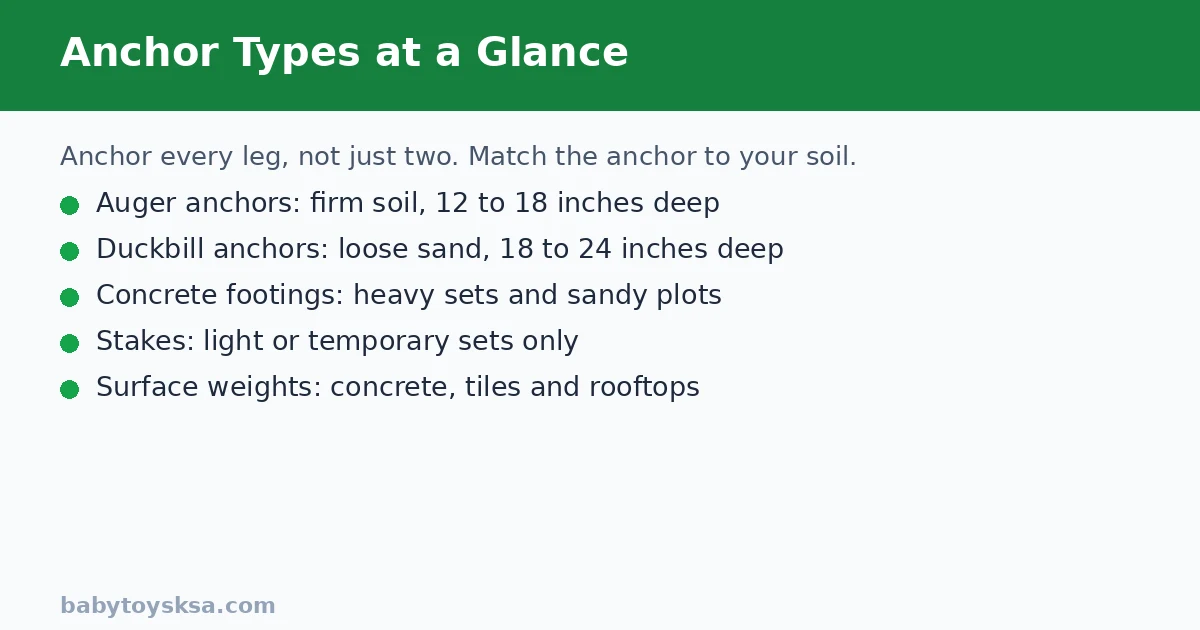
Auger anchors, also called corkscrew anchors, twist into the ground like a giant screw, usually with a removable rod to turn them. They bite deep, pull out hard, and are the usual choice for firm dirt and grass. Guides for home playsets commonly describe augers driven 12 to 18 inches into firm soil as holding most residential sets without concrete. In fact, they are a good match for a compacted Riyadh garden, and they are removable if you move the set.
Duckbill earth anchors are driven in narrow, then flare sideways underground into a wide grip when you pull up on the cable. They give the most holding strength of any no-concrete option and suit loose soil, sand and tall sets. Typically, they sit 18 to 24 inches deep and need a drive rod to install. In short, for a loose sandy plot, a duckbill is usually a better choice than an auger.
Stakes, Concrete Footings and Surface Weights
Stake anchors are sharpened rods you pound straight into the ground. They are cheap and fast, but they are the weakest hold, they back out over time, and they suit only small or temporary sets. Concrete footings set around or below each leg add mass and hold the frame in position, and they work in almost any soil, which makes them the most versatile option, especially in loose sand. Finally, surface anchors do not dig in at all: sandbags, weighted mats and bolt-on stabiliser bars add mass and footprint, and they are how you secure a set that must stand on concrete, asphalt or pavers, where you cannot dig.
Auger or corkscrew anchors hold best in firm dirt, grass and clay, at a typical depth of 12 to 18 inches, for a moderate cost. Duckbill earth anchors hold best in loose soil, sand and tall sets, at a typical depth of 18 to 24 inches, for a higher cost, and they need a drive rod. Stake anchors hold best in light or temporary sets, at a typical depth of 12 to 24 inches, for a low cost. Concrete footings hold best in loose or sandy soil and heavy sets, at a depth set by the manual, commonly deeper than augers, for a moderate to higher cost. Surface weights hold best on concrete, asphalt and pavers, need no depth at all, and cost low to moderate.
Step by Step: Swing Set Anchoring in Your Garden
Step 1: Level the ground. Choose a flat spot with clear space around it, at least 6 feet from walls, fences and trees, and more in front and behind the swings. Remove stones, roots and debris, and level the area so the frame sits evenly. A set on a slope will always pull to one side, and no anchor fixes a slope. Step 2: Assemble the frame exactly as the manual says, on the level ground, and tighten every connection. Do not rely on the frame’s own weight to hold it, and do not anchor a frame that is not fully assembled and square.
Step 3: Mark the anchor positions at every leg. Every leg needs an anchor, not just two of them, because an unanchored leg is the one that lifts first. Step 4: Install the anchors or footings. Drive ground anchors at the marked legs to the depth the anchor needs, or dig holes and pour concrete footings to the depth the manual gives. Measure footing depth from the bottom of the surfacing, not from the lawn, because the surfacing sits on top. For example, home kit manuals compared by Playbright ask for holes from 5 to 20 inches deep, while commercial frames ask for 18 to 42 inches, so the manual for your set governs, and in Saudi gardens, where the ground does not freeze, frost depth does not apply.
Fix the Legs and Bury the Hardware
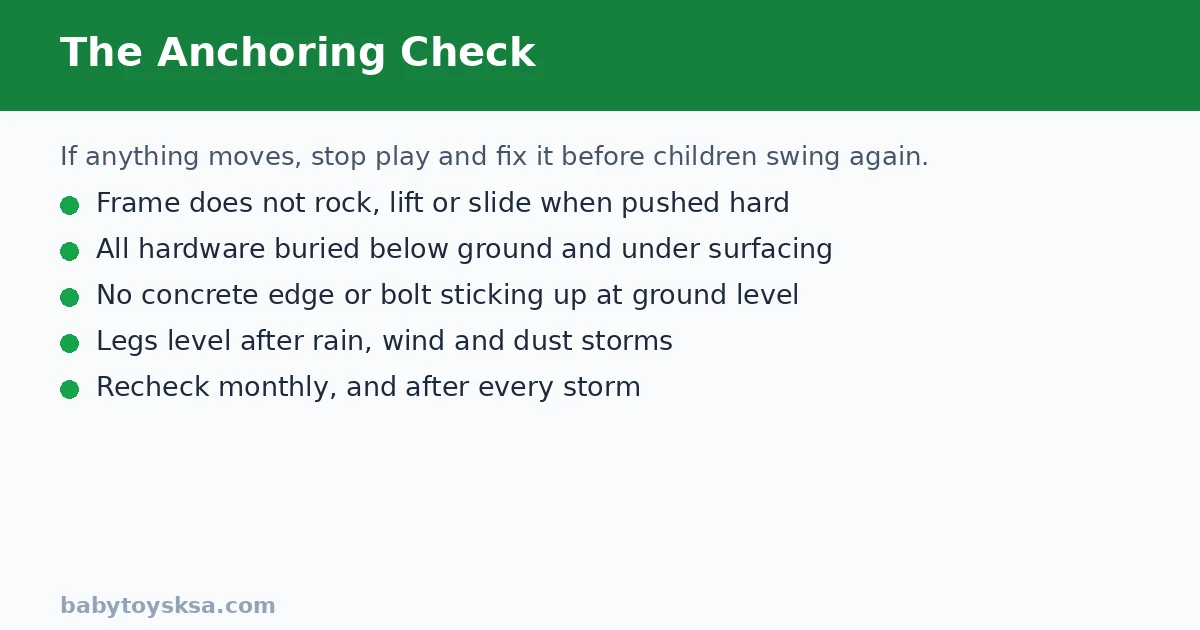
Step 5: Fix the legs to the anchors with the hardware the manual specifies, and check that the frame does not rock, lift or slide. Step 6: Set all hardware below grade. Bury or cover every anchor, plate, bolt and concrete edge under the surfacing, so nothing metal or concrete juts up at ground level. Step 7: Lay the protective surfacing over the whole area, and re-check the frame. Push it hard from the front, the back and the sides, and have an adult sit on each swing in turn while someone watches the legs. Finally, if anything lifts, moves or rocks, stop and fix it before children use the set.
Concrete Footings: When and How
Concrete is the right choice when the soil is loose sand, when the set is tall or heavy, or when wind regularly moves garden furniture. A concrete footing works by mass: a block of concrete around the leg is too heavy for swinging forces to lift. The footing should sit below ground level, with soil and surfacing over the top, so no concrete edge stays exposed. Use a concrete mix suitable for outdoor use, and let it cure fully before children play on the set. Curing takes time, and a footing loaded too early can crack or shift, so wait at least the time the cement bag or your installer advises, and longer in cool weather.
Do not guess the footing size. The manual for your set should specify the footing dimensions, the concrete requirements, and the installation depth, and if it does not, ask the supplier before you dig. A footing that is too shallow or too small is little better than no footing, and a footing poured too high becomes a trip hazard. In short, if you are unsure, a professional installation is the safer choice, and BabyToysKSA installs swing sets with proper footings as part of our installation service across Saudi Arabia.
Anchoring on Hard Surfaces and Rooftops
Some Saudi homes place a swing set on a rooftop, a tiled courtyard or a concrete pad, where digging is impossible. In that case, use surface anchoring: bolt-on stabiliser bars that widen the footprint, weighted mats, or sandbags fixed to the legs. The weights must be heavy enough to resist the swinging force, and fix them so a child cannot pull them off or trip over them. Check the weight of the roof or the tiles underneath as well, because a heavy set plus weights plus children is a real load, and a rooftop needs a professional check before any playset goes on it. Never drill into a roof membrane or a waterproof layer to fix an anchor, because the leak you create will cost far more than the anchor.
Swing Set Anchoring Checks After Wind, Rain and Time
Anchors are not fit-and-forget. Check them once a month, and after every storm, heavy rain or long holiday. Push the frame hard from several directions and watch the legs. Look for gaps opening around the legs, for anchors that have worked up out of the ground, for concrete that has cracked, and for bolts that have loosened. After rain, soft ground lets legs sink unevenly, which twists the frame, so re-check the level and the anchoring together. In Jeddah, check steel anchors for rust, and in Riyadh, check after dust storms, because wind-blown sand can uncover buried hardware.
Re-tighten anything loose, re-bury anything exposed, and top up the surfacing over buried hardware. If an anchor pulls out of the ground, do not just push it back in and hope. The hole is now wider than the anchor, so move the anchor to fresh ground, use a longer anchor, or switch to a concrete footing. Finally, if a leg has bent or a weld has cracked, stop play and get a professional check before children use the set again.
Choosing a Swing Set That Anchors Well
Some sets anchor more easily than others. A set with factory anchor points on every leg, clear instructions for footing size and depth, and a frame that sits flat on level ground will always be easier to make safe. When you buy, ask the supplier what anchoring the set needs and whether installation is included. A supplier who cannot answer that question is not the right supplier.
Swing Sets That Anchor Well
For a small garden, the two-seat swing set with blue and red frame at 200 by 120 by 210 centimetres and 750 SAR is light enough to anchor with augers in firm soil, and easy to test. A three-seat set such as the three-seat swing set with blue and yellow frame at 300 by 130 by 210 centimetres and 900 SAR, or the swing set with three colourful seats and blue and red frame at 300 by 120 by 210 centimetres and 1,100 SAR, puts more load on the frame and benefits from longer anchors or concrete. A four-seat set such as the four-seat swing set with red frame at 400 by 130 by 210 centimetres and 1,050 SAR needs anchors on every leg, and concrete footings are a sensible choice in sandy soil. Swing and slide combinations such as the swing set with yellow slide and blue frame at 400 by 280 by 260 centimetres and 2,800 SAR, or the swing, nest swing and slide combination with red frame and green turf at 300 by 130 by 210 centimetres and 1,300 SAR, need the same treatment on every leg, because the slide adds weight and wind area. Every size and price here comes from the BabyToysKSA product catalogue, and the descriptive names describe the photo, not a supplier model name.
If you are still choosing, browse the swings and slides collection, try the Design Finder tool to match a set to your garden, and ask us about installation and anchoring before you order. In short, a set anchored properly on day one is a set you will not have to worry about for years.
Frequently Asked Questions
Does every swing set need anchoring?
Yes. Anchor every swing set on every leg, whatever its size. The CPSC guidance treats secure footing as a basic requirement, and even a small set can tip when children swing hard or when wind catches it.
What is the best anchor for sandy soil in Saudi Arabia?
In loose sand, long duckbill earth anchors or concrete footings hold best, because short stakes pull out of sand easily. Test your soil first, and when in doubt, choose concrete footings and a professional installation.
How deep should swing set anchors go?
It depends on the anchor type and the manual for your set. Augers commonly go 12 to 18 inches into firm soil, duckbills 18 to 24 inches, and home kit concrete footings range from 5 to 20 inches deep, with commercial frames deeper. Always follow your set’s manual, and measure from the bottom of the surfacing.
Can I anchor a swing set on concrete or tiles?
Yes, with surface anchoring: bolt-on stabiliser bars, weighted mats or sandbags fixed to the legs. Do not drill through a roof membrane or waterproof layer, and get a professional check before putting a set on a rooftop.
How often should I check my swing set anchors?
Check them monthly, and after every storm, heavy rain or dust storm. Push the frame hard from every direction, look for exposed hardware, cracked concrete or loose bolts, and fix anything that moves before children play.
Swing set anchoring is a small job with a large return. An afternoon spent levelling the ground, driving the right anchors for your soil, burying the hardware and testing the frame buys years of safe play. In fact, skip it, and the set will tell you it was skipped, by rocking, sliding, or tipping at the worst possible moment. If you would rather have it done properly, BabyToysKSA installs swing sets across Saudi Arabia with anchoring included. Message us on WhatsApp at +966554340714, email Waqaryounishr23@gmail.com, or browse the swings and slides collection and ask for an installation quote with your order.