

How to Keep Playground Equipment Cool in Saudi Summer
Learning how to keep playground equipment cool summer long is not a comfort extra in Saudi Arabia. It is a safety job. A metal slide in direct sun can get far hotter than the air around it, and a child who sits on it in shorts can burn in seconds, before they have time to move away. The United States Consumer Product Safety Commission warns specifically about hot surfaces and contact burns on metal slides and platforms, and playground safety guides describe dark, sun-facing metal as the worst case on a playground, because metal moves heat into skin far faster than plastic at the same temperature. For example, this guide explains why metal play equipment gets so hot, how hot is too hot, and the practical steps that actually work in a Saudi garden: shade, timing, orientation, colour, water, and the simple touch test that should happen before every summer play session. BabyToysKSA supplies and installs metal and plastic playsets across Saudi Arabia, and everything here suits the real conditions our customers face from May to September.
The Short Version
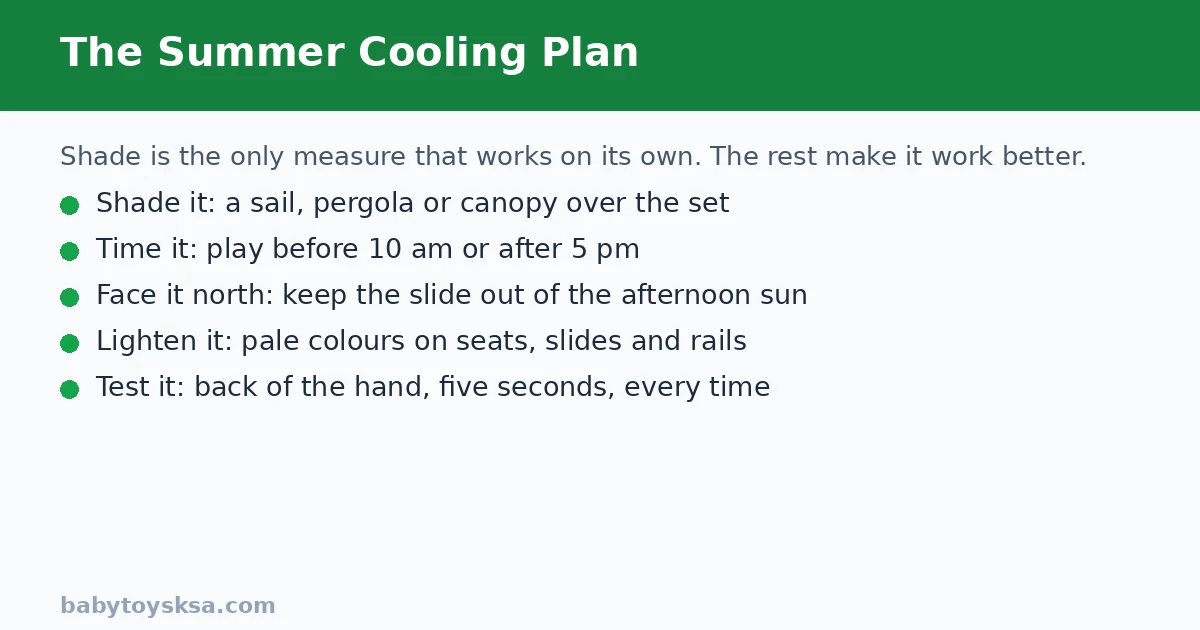
To keep playground equipment cool in summer, shade it, play early or late, choose light colours, and touch-test every metal part before children climb on. Metal heats fast and burns faster than plastic at the same temperature, so shade is the only measure that works on its own.
Quick Answer
The quick answer: put the playset in shade, face slides away from the afternoon sun, play before 10 in the morning or after 5 in the afternoon, and press the back of your hand on every slide, rail and swing seat first. If it is too hot to hold, it is too hot to play on.
Why Metal Play Equipment Gets So Hot
Three things decide how hot a surface gets: colour, which decides how much sun energy it absorbs; thermal mass, which decides how much heat it stores; and conductivity, which decides how fast that heat moves into skin. Metal loses on the last point by a long way. A metal handrail and a plastic panel at the same temperature are not the same hazard, because the metal pushes its heat into a small hand far faster. Dark colours absorb more sun than light ones, so a dark green or black metal slide heats faster than a light grey or white one. A dense material also holds its heat after the sun moves off, so a west-facing slide can still be hot in the early evening, long after the shade has arrived.
Air temperature tells you almost nothing about whether a slide is safe to touch. Playground safety research summarised by Playbright notes that a dark, dense, sun-facing surface in full summer sun commonly sits 30 to 60 degrees Fahrenheit above the air temperature, which can turn a 90 degree Fahrenheit afternoon into a 140 degree Fahrenheit slide. Around 120 degrees Fahrenheit it takes several minutes of contact to injure skin, and around 140 degrees Fahrenheit it takes seconds. Those are approximate thresholds from burn literature for adult skin, and children’s skin is thinner and more vulnerable, so treat them as a warning, not a safe limit. In short, the practical rule is simpler: if you would not hold your hand on it, a child should not sit on it.
The Touch Test: Your First Check Every Time
Before every summer play session, press the back of your hand on each surface a child will touch: the slide bed, the top platform, the handrails, the ladder rungs, the swing chains and the swing seats. The back of the hand is more sensitive than the palm, and it gives a fair test of what a bare leg or a small hand will feel. Hold it there for five seconds. If it feels uncomfortably hot, the equipment is not ready. Test the whole slide, not just the top, because the middle of the chute is often the hottest part, and test swing seats as well, because dark plastic seats also heat up.
Teach older children to do the same test themselves, and make it a rule, not a suggestion: no touch test, no play. Children who have tested the slide themselves are far less likely to run straight onto a hot one. Finally, keep a note of which parts heat first in your garden, because the same parts will heat first every day, and that tells you where shade will help most.
Shade: How to Keep Playground Equipment Cool Summer Long
Shade is the single most effective way to keep playground equipment cool in summer, and playground safety experts are clear that light colours, orientation and material choice help, but none of them on their own stops a surface in full desert sun from reaching burn temperature. Shade does, and it works on two things at once: it keeps the equipment cool enough to touch, and it keeps the surfacing underneath cool enough to walk on. In fact, a shaded playground stays usable through hours when an exposed one is empty.
Shade Sails, Pergolas and Trees
Shade sails are the most flexible option for a home garden. A sail stretched over the playset blocks the midday sun and you can take it down in winter. Meanwhile, a pergola or a fixed canopy gives permanent shade and you can plant a climber on it for extra cover. And a large garden umbrella shades a small swing set or a seesaw. Trees give the best shade of all and cool the air around them, but they take years to grow, so plant them now for the summers ahead and use a sail in the meantime. Finally, when you place shade, think about the sun’s path: shade the equipment during the hours children actually play, not just at noon, and remember that a playground shaded at nine in the morning can be unusable by eleven, because the sun moves.
Canopy swings solve the shade problem for one piece of equipment at a time. The canopy bench swing with red seat and blue and white canopy at 200 by 130 by 210 centimetres and 1,200 SAR, and the canopy swing set with red seats, blue frame and patterned canopy at 400 by 130 by 210 centimetres and 1,350 SAR, both carry their own shade over the seats. Every size and price here comes from the BabyToysKSA product catalogue, and the descriptive names describe the photo, not a supplier model name. In short, a canopy does not shade the whole playset, but it keeps the seats a child sits on out of direct sun, which is where contact burns happen most.

Orientation: Face the Slide Away From the Afternoon Sun
Where the playset sits, and which way it faces, changes how hot it gets. In Saudi Arabia the afternoon sun comes from the west and is the hottest of the day, so a slide facing west takes the full force of it on the chute, the part children sit on. A slide facing north, or placed so the chute is shaded during peak hours, runs cooler. Meanwhile, a slide tucked against a west wall is worse, because the wall reflects heat back onto it and the surface stays hot longer after the sun moves off.
When BabyToysKSA installs a playset, orientation is part of the planning, and it costs nothing to get right at installation time and a lot to fix later. If your set already faces west, a shade sail on the west side, or a tall plant or screen that blocks the afternoon sun, can fix most of the problem. Finally, watch your garden for a day and note where the shade falls at ten in the morning, at noon, and at four in the afternoon, then place the shade where the equipment sits exposed during play hours.
Light Colours and Coated Metal
Colour is the lever you control when you buy. Dark colours absorb sun and heat up fastest, while light colours reflect it. A light grey, white, cream or pale green slide runs meaningfully cooler than a black or dark green one, and the same applies to surfacing: a light-coloured rubber tile or mulch runs cooler than a black one. When you choose a playset, ask for light colours on the parts children touch most, the slide bed, the seats and the handrails, even if darker colours look smarter on the frame.
Coating matters too. Bare metal is the worst case for burns, because it conducts heat fast and has nothing to slow it down. Powder-coated metal, the finish used on the BabyToysKSA steel frames, is better, because the coating slows heat transfer a little and protects the steel from rust. Plastic slide beds and seats heat more slowly than metal and transfer heat more slowly, which is one reason many modern sets mix materials: a steel frame for strength, with plastic at every point a child grips or sits. In short, if you have old bare metal equipment in a sunny position, shade it or replace the contact parts, because no amount of paint will make bare metal safe in full July sun.
Water, Hosing Down and Misting
Water cools a hot slide fast, and a hose is the quickest fix when children want to play now. Hose down the slide bed, the platform and the swing seats, then wait a minute and touch-test again. The cooling lasts only while the surface stays wet and shaded, because a wet metal slide in full sun heats up again within minutes, so hosing down is a start-of-play measure, not a solution for the afternoon. Never let children play on a slide that is wet and slippery without checking the landing, and never hose down electrical parts or a surface that will become dangerously slippery.
A fine mist from a garden mister, or a damp towel laid over a hot swing seat for a few minutes, can make a seat usable while the shade catches up. A small paddling pool or water tray in the shade gives children a way to cool off between turns on the equipment, which matters because heat exhaustion, not just burns, is a summer risk. Finally, keep drinking water in the shade beside the playset, and bring children inside for a break every twenty to thirty minutes in the hottest part of the day.
Timing: Keep Playground Equipment Cool Summer Mornings and Evenings
In a Saudi summer, the cheapest way to keep playground equipment cool is to choose the hours. Play before ten in the morning or after five in the afternoon, when the sun is lower and the equipment has had time to cool. The middle of the day, roughly eleven to four, is when surfaces are hottest and when children are at most risk of both burns and heat exhaustion. In fact, a playset that is unusable at noon is perfectly usable at six in the evening, and the same set that burns at two in the afternoon may be cool and pleasant at eight in the morning.
Build the routine around the heat. In the morning, touch-test, hose down if needed, and play while the garden is still in shade. At midday, keep children inside, in a shaded pool, or in an air-conditioned room. In the late afternoon, test again, because a west-facing slide can still be hot after the sun has moved, and dense materials hold their heat. For example, the World Health Organization recommends that children aged 5 to 17 average at least 60 minutes of moderate to vigorous activity a day, and in a Saudi summer the easiest way to reach that is two shorter play sessions, morning and evening, rather than one long session in the heat.
Clothing, Footwear and Skin Protection
What children wear changes the burn risk. Shorts and bare legs on a hot slide are the classic burn, because the skin sits directly on the hot surface. Light, loose trousers or leggings protect legs on the slide, and closed shoes protect feet on hot surfacing. A hat and sunscreen protect against sunburn and heat, but they do not protect against a contact burn from a hot slide, so clothing is a back-up, not a replacement for the touch test and shade. Finally, teach children to sit, not lie, on a slide they are unsure about, and to tell an adult at once if a surface feels too hot.
What to Buy If Your Set Is Always Too Hot
If your playset is too hot to use for most of the summer, the fix is usually shade or orientation, not a new playset. A shade sail costs far less than a new set and makes the set you already own usable again. If you are buying new, choose light colours, plastic contact parts, and a canopy where it matters. In short, a small set in the shade beats a big set in full sun every time, because the shaded set gets used and the sunny set sits empty.
For a small shaded corner, the single green slide with metal frame at 220 by 140 centimetres and 1,200 SAR is easy to shade with one sail. A family set such as the swing set with red slide, purple frame and bear toppers at 310 by 280 by 260 centimetres and 2,600 SAR needs a larger sail or a pergola, because the swings and the slide both need cover. A tower such as the tower playset with red double slide, swings and blue roof at 340 by 280 by 290 centimetres and 3,300 SAR has its own roof over the platform, which shades the top, but the slide chute and the swings still need shade of their own. Every size and price here comes from the BabyToysKSA product catalogue. Finally, if you are planning a new garden, use our Design Finder tool and talk to us about orientation and shade before someone installs the set, through our installation service, because getting the position right on day one saves a summer of hot slides.
A Summer Daily Routine That Works
Morning, before play: touch-test every surface, hose down anything warm, check the shade is in place, and put drinking water in the shade. Play in the morning while the garden is cool. Midday: bring play inside or into full shade, and let the equipment cool. Late afternoon: touch-test again, because dense parts hold heat, and play again in the evening when the sun is low. Weekly: check that the shade sail is tight and undamaged, that no branch has grown over the set and changed the shade pattern, and that the slide coating has not peeled, because peeling coating exposes bare metal and makes burns more likely.
Keep the routine simple enough to do every day. A five-minute touch test and a hose-down are the difference between a playset that gets used all summer and one that sits empty from June to September. In fact, children remember the summers they played outside, not the summers they watched the garden from the window.
Frequently Asked Questions
How hot can a metal slide get in Saudi Arabia?
A metal slide in direct sun can sit far hotter than the air temperature, and published playground heat guidance notes dark, sun-facing surfaces commonly running 30 to 60 degrees Fahrenheit above air temperature. At around 140 degrees Fahrenheit, contact can burn skin in seconds, so always touch-test before play.
Does hosing down a slide keep it cool?
Hosing down cools a slide fast, but only for a short time. A wet metal slide in full sun heats up again within minutes, so use water at the start of play and combine it with shade for a lasting fix.
Are plastic slides safer than metal slides in the heat?
Plastic heats more slowly than metal and moves heat into skin more slowly, so it is safer to touch at the same temperature. Dark plastic still gets hot, so plastic is better, but it still needs shade and a touch test in a Saudi summer.
What time of day is safest for outdoor play in summer?
Early morning before ten, and late afternoon after five, are the safest times. Avoid the middle of the day, roughly eleven to four, when surfaces are hottest and heat exhaustion is most likely.
Can a shade sail really make a difference?
Yes. Shade is the most effective single measure for keeping equipment cool, because it stops the sun reaching the surface at all. A well-placed sail can make a playset usable for hours you would otherwise lose to the heat.
Keeping metal play equipment cool in a Saudi summer comes down to three habits: shade it, time it, and touch-test it. Shade stops the heat reaching the metal, morning and evening play avoids the worst of it, and the back-of-the-hand test catches the days when the other two are not enough. In short, if your garden playset sits empty every summer, the answer is usually not a new set but a sail, a better position, or a lighter colour. Talk to BabyToysKSA on WhatsApp at +966554340714 or by email at Waqaryounishr23@gmail.com, browse the shop, or try the Design Finder, and we will help you plan a garden your children can actually play in, even in July.