

Playground Safety Flooring: What to Put Under Swings and Slides
Playground safety flooring is the part of a playset most parents think about last, and it is the part that matters most when a child falls. Most playground injuries happen in falls, and the surface a child lands on decides whether a fall is a fright or a hospital visit. The United States Consumer Product Safety Commission notes that about 80 percent of playground injuries occur when children fall from equipment, which is why protective surfacing sits at the centre of every serious playground safety guide. For example, this playground safety flooring guide compares the real options for a Saudi garden, sand, pea gravel, wood mulch, rubber mulch, rubber tiles, wet pour rubber and grass, with the depths each one needs, how they behave in Saudi heat and dust, and how to keep them working year after year. BabyToysKSA supplies and installs playsets across Saudi Arabia, and this guide uses the same thinking our installation teams use when they prepare the ground under a new set.
The Short Version
Playground safety flooring is the soft, impact-absorbing layer under and around play equipment that cushions falls. The right choice depends on the height of your equipment, your budget, and how much maintenance you will do in Saudi heat and dust.
Quick Answer
The quick answer: never put swings or slides over concrete, tiles or bare earth. Use a tested impact-absorbing surface, deep enough for the fall height of your equipment, kept topped up and clear of the landing zones. Under the European EN 1177 approach, equipment needs surfacing wherever the free height of fall is above 0.6 metres.
Why Playground Safety Flooring Matters More Than the Equipment
A strong frame and smooth slide are important, but they do not soften a landing. A child who slips from a swing seat or a platform falls onto whatever is underneath, and the surface has to absorb that energy. Hard surfaces such as concrete, asphalt, paving slabs, ceramic tile and compacted earth do not absorb impact at all, and they should never sit under equipment a child can fall from. Finally, grass looks soft, but dry, compacted Saudi garden grass over hard earth gives very little protection, and it wears bare exactly where children land most.
Safety standards describe this with a simple number called the fall height. Under the European standard EN 1176, the whole impact area needs impact-absorbing surfacing to EN 1177 wherever equipment has a free height of fall greater than 0.6 metres, and also at any height under equipment that puts a child into forced movement, such as swings, slides, roundabouts and seesaws, because a child can be thrown clear rather than simply dropping. In short, that 0.6 metre line is a useful rule for a home garden: if a child can fall from higher than your knee, the ground underneath needs to be a proper safety surface.
The Two Families: Loose-Fill and Unitary Surfaces
Every playground safety flooring option falls into one of two families. Loose-fill surfaces are loose materials you spread and top up: sand, pea gravel, wood mulch, wood chips and shredded rubber. Unitary surfaces stay fixed in place: rubber tiles, wet pour rubber, and bonded rubber mulch. Loose-fill is usually cheaper to buy and easy to top up, but it moves, compacts and blows away, so it needs regular checking. Unitary surfaces cost more up front and need a prepared base, but they stay in place, stay level, and are easier to keep clean. In fact, in a Saudi garden, wind and dust push many families toward unitary surfaces, while families on a tighter budget often start with loose-fill and top it up often.
Sand: Cheap, Familiar, and Limited
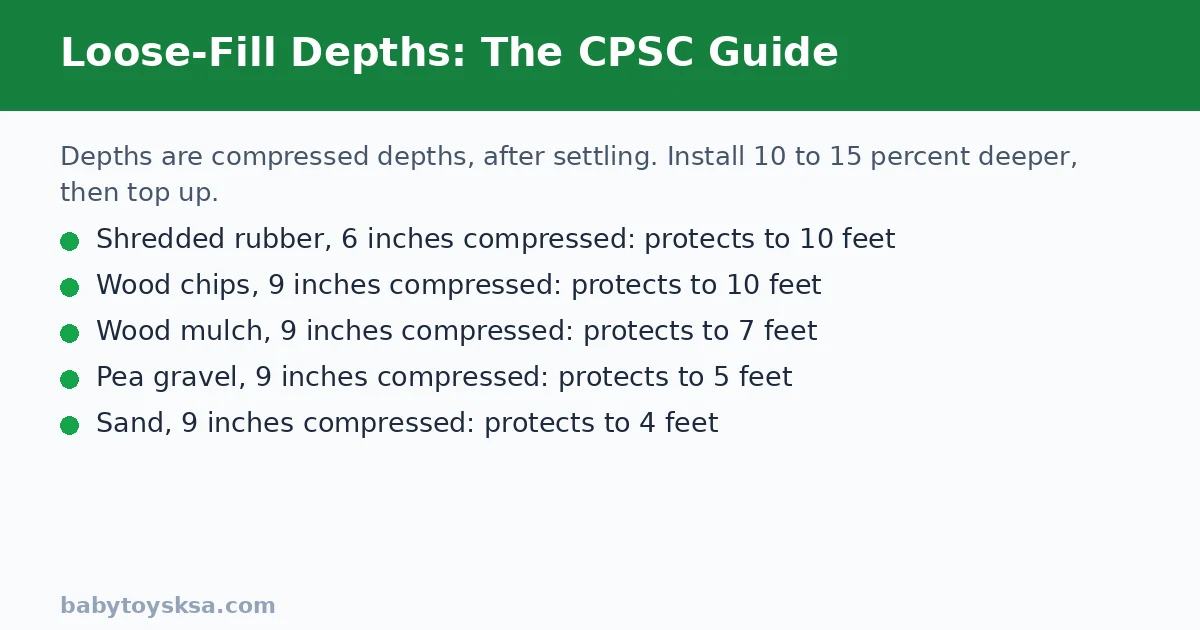
Sand is the most familiar playground safety flooring in Saudi Arabia, because it is cheap, easy to buy, and children love playing in it. As a safety surface it has real limits. The United States Consumer Product Safety Commission table for loose-fill surfacing gives sand a minimum compressed depth of 9 inches, protecting a fall height of only 4 feet, which is about 1.2 metres. In short, that is the lowest protection of any loose-fill material in the table, so sand alone is not enough under a tall tower playset or a high swing. Finally, sand also compacts, gets kicked away from landing spots, blows in wind, and in a Saudi garden it heats up in the sun and can hide animal waste. For example, never lay sand over concrete or asphalt, because the hard layer underneath removes the protection.
Pea Gravel and Wood Mulch: Better Protection, More Upkeep
Pea gravel is small, rounded stone that drains well and does not break down, which suits Saudi gardens that get occasional heavy rain. The CPSC table gives 9 inches of compressed pea gravel a protected fall height of 5 feet, about 1.5 metres. Its weakness is that small stones scatter around, get into shoes and pockets, and can be a choking risk for toddlers, so it suits older children better. Wood mulch and wood chips protect better: 9 inches of compressed wood mulch protects a fall height of 7 feet, and 9 inches of wood chips protects up to 10 feet, according to the same CPSC table. Finally, wood breaks down in heat and sun, compacts, and needs topping up, and never treat it with chromated copper arsenate, known as CCA. In Saudi Arabia, good quality wood mulch can be harder to source than sand or rubber, so check supply before you commit to it.
Rubber Mulch: The Highest Protection per Inch
Shredded or recycled rubber mulch is the most protective loose-fill material in the CPSC table: only 6 inches compressed protects a fall height of 10 feet, about 3 metres. It does not compact the way wood does, it drains well, it does not attract insects, and it keeps its depth for longer. Its weaknesses in a Saudi garden are heat and looks. Dark rubber mulch gets very hot in direct sun, so shade it or choose it in a light colour where children land barefoot or in shorts. It can also smell when new, and cheap rubber mulch can contain wire fragments, so buy from a reputable supplier and check it by hand before children play on it. In short, lay it over a weed barrier on a level, draining base, and rake it back into the landing zones every week, because children still kick it aside.
Rubber Tiles: Neat, Fixed, and Easy to Repair
Rubber safety tiles are interlocking squares, usually 500 by 500 millimetres, laid over a prepared flat base. Their protection depends on thickness: as a rough guide from United Kingdom surfacing guides, a 40 millimetre tile protects to about 1.0 to 1.2 metres, a 50 millimetre tile to about 1.5 to 1.8 metres, a 65 millimetre tile to about 2.0 to 2.5 metres, and an 80 millimetre tile to about 3.0 metres. Always confirm the exact figure against the tile maker’s own test report, because the rating belongs to the tested product and thickness, not to rubber tiles in general. Tiles suit families who want a tidy garden, because they stay put, drain through their joints, and you can lift and replace a damaged tile without redoing the whole area. Finally, dark tiles get hot in Saudi sun, so choose lighter colours for the landing zones and shade the area if you can.
Wet Pour Rubber: The Smoothest Finish
Wet pour rubber, also called poured-in-place rubber, is a seamless layer of rubber granules bound together on site over a prepared base. Its protection depends on its thickness, with indicative United Kingdom figures of about 1.0 metre of protection at 40 millimetres, 1.5 metres at 60 millimetres, 2.0 metres at 80 millimetres and 2.5 metres at 100 millimetres, always confirmed against the installer’s own test certificate. Wet pour looks the most professional, has no trip edges, is easy to sweep, and you can lay it in colours and patterns. It is also the most expensive option and the hardest to repair: a damaged patch usually needs a professional repair, and a poor base or a bad mix can crack or peel in Saudi heat. For example, if you choose wet pour, use an installer who can show you a test certificate for the exact thickness they will lay, and ask how the material behaves in high summer temperatures.
Grass, Artificial Turf and the Surfaces to Avoid
Natural grass is a pleasant play surface, but on its own it is not playground safety flooring. Grass over hard, dry earth gives almost no impact protection once it wears thin, which happens first exactly where children land. Rubber grass mats, perforated mats laid over grass that the grass grows through, add some protection, typically to a fall height of about 1.0 to 1.3 metres, and they suit low equipment. Artificial turf looks tidy and stays green, but in Saudi sun it gets very hot, with no cooling by evaporation, and on its own it protects little. Turf over a shock pad performs better, but the pad, not the turf, is doing the safety work, so ask for the pad’s own test rating.
The surfaces to avoid under any equipment higher than 0.6 metres are concrete, asphalt, paving slabs, ceramic tile, compacted hardcore and bare hard earth. Decorative rubber chippings that carry no test certificate are also not a substitute for certified impact-absorbing surfacing. In short, if a product cannot show you a fall-height rating, treat it as decoration, not safety flooring.
Matching Depth to Your Equipment
Start from the highest point a child can fall from on your set, which is the free height of fall. For a small slide or a low swing seat that may be under a metre, while a tower playset platform can be two metres or more. The surface under it needs a rating of at least that height. The CPSC loose-fill figures are a good planning guide: 9 inches compressed of sand protects to 4 feet, 9 inches of pea gravel to 5 feet, 9 inches of wood mulch to 7 feet, 9 inches of wood chips to 10 feet, and 6 inches of shredded rubber to 10 feet. For unitary surfaces there is no general table, because performance depends on the binder, the granule size, the density and the base, so the maker’s own test report for that exact thickness is the only figure that counts.
Measure the depth properly. Loose-fill depth means compressed depth, the depth left after the material has settled, not the depth on the day it was delivered. Install loose-fill about 10 to 15 percent deeper than the target, or about 12 inches where you need 9 inches compressed, and check it with a ruler pushed through the material to the base. Check in the landing zones, not at the edges, because that is where children displace it. Mark the target depth on a leg of the playset with paint or tape, so anyone can see at a glance when a top-up is due.
Cover the whole impact area, not just a small mat under the slide. The surfacing zone extends around the equipment, and for swings it extends further in front and behind, because a child leaves the seat moving. Finally, when you plan the area, allow for the full footprint of the set plus the space around it, and keep the surfacing inside a border or edging so it does not spread across the garden.
Playground Safety Flooring in Saudi Heat, Dust and Rain
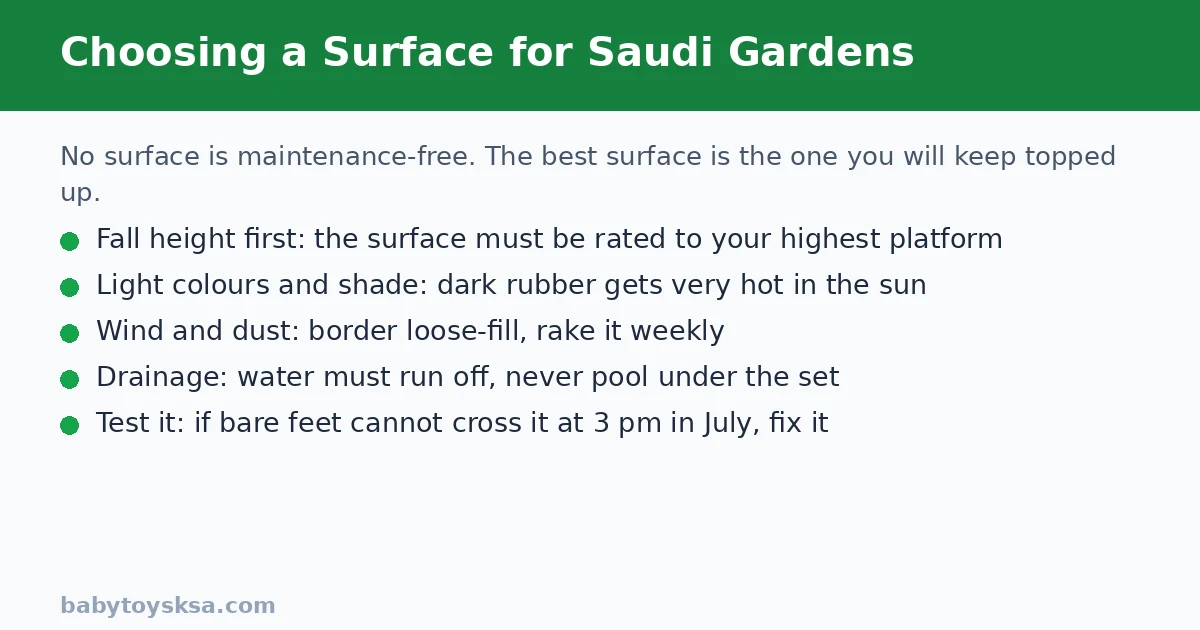
Saudi conditions change the choice. Dark surfaces, whether rubber tiles, wet pour or rubber mulch, absorb sun and can become too hot for bare feet and bare legs, so lighter colours and shade matter as much as fall protection. Loose-fill blows in wind and sandstorms, so a bordered area and a weekly rake are not optional. Dust settles into every surface, so sweep unitary surfaces and hose them down when they get gritty, because grit makes them slippery. Occasional heavy rain needs drainage: a surface that holds water becomes slippery and, for loose-fill, washes away from the landing zones. A slight fall on the base, away from the house, and a free-draining sub-base keep water moving.
Coastal Jeddah adds salt air, which attacks metal edging and fixings, so choose plastic or coated edging near the coast. In Riyadh, dust is the bigger enemy, and a surface that is easy to sweep wins. In fact, in every Saudi city, the practical test is simple: at three in the afternoon in July, can a barefoot child walk across it comfortably? If not, the surface needs shade, a lighter colour, or a different material.
Installation, Maintenance and When to Replace
Prepare the ground before the surface goes down. Level the area, remove stones and roots, and lay a draining base. For loose-fill, lay a weed barrier that still lets water through, and fit a border to hold the material in place. Meanwhile, for tiles and wet pour, the base must be flat, firm and dry, because an uneven base shows through and cracks the finish. BabyToysKSA installs playsets across Saudi Arabia, and ground preparation is part of planning an installation, so ask us about the surfacing zone when you order a set through our installation service or try the Design Finder tool to match a set to your garden.
Maintain the surface on a routine. Weekly: rake loose-fill back into the landing zones, check the depth with a ruler, remove stones, glass and animal waste, and sweep unitary surfaces. Monthly: check tiles for lifting edges, check wet pour for cracks or peeling, and look for thinning or bare patches. After a storm: check that wind has not blown loose-fill away and that rain has not washed it into drifts. Replace loose-fill when it no longer holds its depth even after topping up, when it has broken down into dust, or when it smells bad and will not clean. And replace tiles or wet pour when the surface is cracked, lifting, or worn thin enough that the base shows through.
Choosing Flooring for BabyToysKSA Playsets
Match the flooring to the set you own. A low, compact set such as the single green slide with metal frame at 220 by 140 centimetres and 1,200 SAR, or the metal slide in silver and green at 250 by 140 centimetres and 450 SAR, has a low fall height and can work with sand or rubber mulch at the right depth, though rubber mulch protects further. A mid-size swing and slide set such as the swing set with yellow slide and blue frame at 400 by 280 by 260 centimetres and 2,800 SAR needs a surface rated to its platform and swing heights, which usually means rubber mulch, tiles or wet pour. A large tower such as the large tower playset with tunnel slide, yellow slide, green spiral slide and swings at 700 by 440 by 360 centimetres and 7,400 SAR needs the deepest protection you can fit, with the surface rated to the highest platform on the set. Every size and price here comes from the BabyToysKSA product catalogue, and the descriptive names describe the photo, not a supplier model name.
If you are buying a set and flooring together, decide the flooring first and the set second, because the flooring sets the safe height limit for the garden. A beautiful tower on bare tiles is not a safe playground. In fact, a modest set on a deep, well-kept safety surface is. Browse the large playsets and towers and swings and slides collections, and ask us for a quote that includes ground preparation and surfacing advice for your garden.
Frequently Asked Questions
What is the best playground safety flooring for a home garden?
There is no single best choice. Rubber mulch gives the highest protection per inch of loose-fill and is easy to top up. Rubber tiles and wet pour stay in place and look tidy but cost more. Choose by fall height first, then by heat, maintenance and budget.
How deep should playground safety flooring be?
For loose-fill, the CPSC minimum compressed depths are 9 inches for sand, pea gravel and wood mulch, and 6 inches for shredded rubber. Install about 10 to 15 percent deeper to allow for settling, and check the depth in the landing zones with a ruler.
Is sand safe under a swing set?
Sand is a real safety surface, but it protects the least: 9 inches compressed protects a fall height of only 4 feet. It suits low equipment, and it needs frequent raking and topping up. Under a tall set, rubber mulch, tiles or wet pour protect further.
Can I put a playset on grass?
Grass alone is not safety flooring. Dry, worn grass over hard earth gives very little impact protection. Keep grass for the garden around the play area, and put a tested safety surface under the equipment itself.
Does playground safety flooring get hot in Saudi Arabia?
Yes, dark rubber and artificial turf get very hot in direct sun. Choose light colours, shade the play area, and test the surface with the back of your hand before children play in bare feet.
Playground safety flooring is not decoration. It is the part of the playground that does the work when a child falls, and it deserves the same care as the playset itself. In short, measure your fall height, choose a surface rated to at least that height, install it deep enough, and keep it topped up and clean. If you are planning a new playset for your Saudi garden, talk to BabyToysKSA first: browse the shop, try the Design Finder, or message us on WhatsApp at +966554340714, and we will help you match the set and the surface to your garden.